
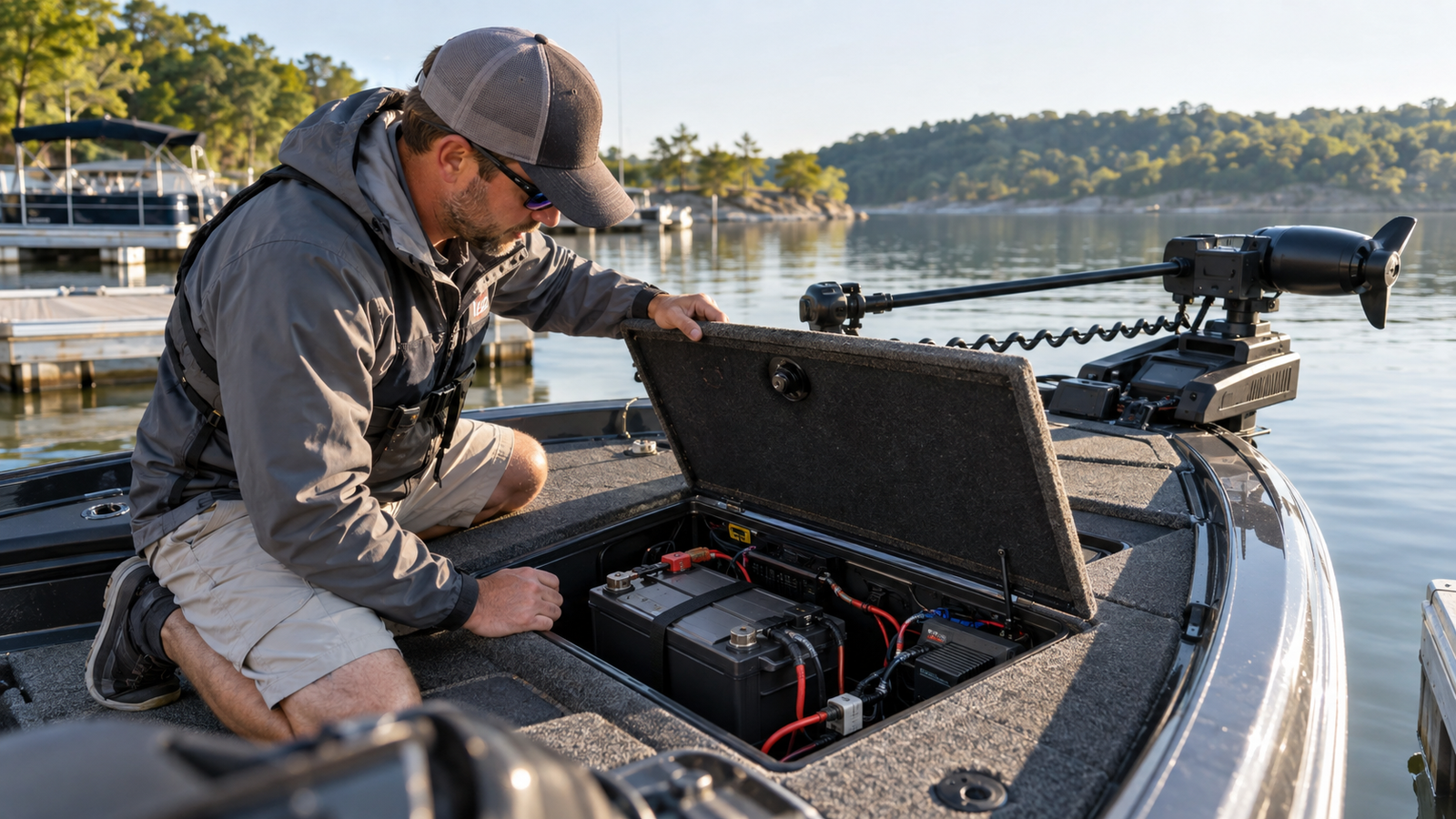
Do not select a lithium trolling motor battery by thrust rating or amp-hours alone. Start with your exact motor’s required system voltage and maximum current draw; then check the battery’s continuous BMS output and overcurrent trip limits, the charger’s battery-specific profile, and whether the battery is designed for marine deep-cycle or engine-start duty. A battery can be advertised for a “100 lb trolling motor” yet still be a poor match for a particular motor drawing more current than its BMS permits.
This guide examines current U.S. WattCycle trolling-motor listings alongside Minn Kota’s own motor and charger guidance. These are document-based comparisons, not on-water testing or confirmation of compatibility with every motor model.
Start with this three-gate compatibility rule
- Voltage gate: match the motor’s specified 12V, 24V or 36V system. A larger Ah number cannot fix the wrong voltage.
- Discharge gate: the correct battery/BMS must support the motor’s maximum specified draw and relevant transient behavior, not merely its cruising average. Minn Kota explicitly advises checking BMS continuous current against motor maximum current in its lithium battery guide.
- Charging/installation gate: confirm the charger profile and pack configuration, plus manufacturer-approved installation and applicable marine standards. A 12V-per-bank charger is not automatically suitable for a single-case 24V or 36V battery.
What WattCycle’s three trolling-specific models actually specify
The figures below are published by WattCycle for the exact linked variants as reviewed October 13, 2026. The capacity is nameplate energy, and IP ratings are vendor-stated marketing/specifications, not independently verified marine certifications.
| WattCycle named battery | Nominal voltage / energy | Published continuous discharge | Published charger target | Primary concern |
|---|---|---|---|---|
| 12V 100Ah TM Bluetooth | 12.8V × 100Ah = 1,280Wh | 120A | 14.6V ± 0.2V (CC/CV) | Check motor’s real maximum current, 12V charging-bank compatibility and marine mounting. |
| 24V 50Ah TM Bluetooth | 25.6V × 50Ah = 1,280Wh | 50A | 29.2V ± 0.32V (CC/CV) | May not cover a motor whose specified maximum draw exceeds 50A, despite promotional thrust ranges. |
| 36V 50Ah TM Bluetooth | 38.4V × 50Ah = 1,920Wh | 50A | 43.8V ± 0.48V (CC/CV) | Same 50A continuous BMS question at a higher motor-system voltage. |
Critical finding: Minn Kota’s published selection/wiring table lists 60A maximum draw for its QUEST 24V and QUEST 36V motor entries, with a note that maximum draw occurs intermittently under select conditions. WattCycle lists only 50A continuous discharge for its separate 24V 50Ah and 36V 50Ah TM packs. Its product pages list an overcurrent protection threshold beginning around 60A for 9–12 seconds. This is a real compatibility question—not proof of guaranteed failure. Do not assume those 50A batteries cover the full QUEST operating envelope without written model-specific confirmation about current profile and BMS trip behavior. Minn Kota’s guidance to compare continuous BMS and motor maximum draw makes a conditional/no-buy verdict the prudent default where that confirmation is missing.
How to estimate runtime without repeating marketing promises
For a single battery supporting a motor at roughly stable current, a best-case simplified upper-bound is rated amp-hours divided by actual average current in amps. Example: a hypothetical motor averaging 25A on a 50Ah pack gives 50Ah ÷ 25A ≈ 2 hours before allowing for discharge cutoff, capacity variation, temperature, speed changes or reserve. That is mathematics, not an expected real-life trip length.
| Hypothetical average motor current | 50Ah nominal battery ideal Ah/current time | 100Ah nominal battery ideal Ah/current time |
|---|---|---|
| 15A | 3.33 hours | 6.67 hours |
| 25A | 2.00 hours | 4.00 hours |
| 40A | 1.25 hours | 2.50 hours |
| 55A | Not continuously valid for a 50A BMS | 1.82 hours in ideal Ah arithmetic only, if the motor/battery voltage and BMS match |
Read rows only within the correct voltage family. The 100Ah column is not permission to connect a 12V battery to a 24V or 36V motor. Near the BMS threshold, current protection can terminate a trip long before the Ah calculation predicts depletion. Boat load, weed entanglement, high speed, wind, propeller selection and motor electronics affect demand; use your actual motor manual or logged current, not a thrust-to-amps guess.
Motor generation matters: QUEST vs older brushed Minn Kota motors
The motor maker itself distinguishes motor types. Minn Kota says its QUEST range is optimized for LiFePO4 on 24V/36V systems, but this is not a blanket approval of every third-party lithium battery or undersized BMS. For its brushed trolling motors, Minn Kota recommends limiting motor speed to 85% or speed setting 8.5 when using lithium due to the sustained higher battery voltage. That instruction applies to the motor type in the source—not all trolling motors worldwide.
If your motor maker discourages lithium or requires a battery condition you cannot satisfy, do not let a seller’s “up to 120 lb thrust” slogan override that restriction. A compatible, properly maintained marine deep-cycle AGM bank can remain a valid alternative for a brushed or older setup.
One battery at 24V/36V, or multiple 12V batteries?
These are different architectures with different charging requirements. Minn Kota’s wiring guide explains that two 12V batteries are used in series to form a 24V system, and three 12V batteries in series form a 36V system. Parallel connection of equal-voltage packs increases available capacity at approximately the same voltage; it does not make 12V packs into a 24V or 36V bank.
This distinction matters because WattCycle’s 36V trolling-motor kit page and navigation currently label a three-12V package as “in parallel,” contradicting the electrical definition and Minn Kota’s installation instructions. Treat that phrase as unresolved marketing documentation, not wiring guidance. Confirm with WattCycle the exact series compatibility of the exact 12V SKU, BMS conditions, number of permitted batteries and approved charger arrangement in writing before considering a multi-battery pack. Do not infer series approval merely because the label says “4S4P” or shows a bundle.
Do not use this article as a wiring diagram. Follow the specific marine motor, battery and charger manuals; ensure the correct circuit protection, isolation, wiring and professional checks for the boat.
The charger trap: PCL 12V banks are not single-pack 24V chargers
Minn Kota states in its Precision Charger Lithium (PCL) specifications that its onboard PCL charger banks support 12V LiFePO4 batteries and are not compatible with a single 24V or 36V lithium battery. It quotes a per-bank maximum of 14.5V and instructs buyers to confirm the profile with the battery maker. WattCycle’s 12V TM page lists a 14.6V ±0.2V target, but similar-looking voltage numbers do not prove a particular charger’s full algorithm and current are approved.
| Battery configuration | Charger question | Rule before buying |
|---|---|---|
| One 12V WattCycle TM battery | Does this individual 12V charger bank’s current/profile meet the exact WattCycle manual? | Confirm both manufacturers’ limits; a 14.5V PCL maximum versus 14.6V nominal target requires manufacturer-level approval. |
| One single-case 24V WattCycle TM battery | Can the charger deliver the required model-specific 29.2V CC/CV profile? | Do not attach a Minn Kota PCL 12V bank and presume compatibility. |
| One single-case 36V WattCycle TM battery | Can the charger deliver the required model-specific 43.8V CC/CV profile? | Use only the battery-manufacturer-approved correct-voltage charging solution. |
| Multiple 12V packs in approved series | Does the charger isolate/charge each battery as required and do both makers authorize the setup? | Require written battery, motor and charger confirmation and proper installation; series approval is model-specific. |
WattCycle’s published 24V TM and 36V TM pages each list a recommended 10A charge current. Compare that to the charger output actually available; do not assume more charging amperes always means safer or faster charging. Check charging-temperature restrictions before leaving the boat on a charger in freezing conditions.
Marine environment and starting-duty: two separate risks
WattCycle markets the 12V TM Bluetooth as IP67 and its 24V/36V TM models as IP65. Those are seller-published ingress ratings, not proof that any assembled installation, terminal, fuse holder or cable connection is suitable for immersion or unrestricted saltwater exposure. Confirm mounting instructions, corrosion protection, vibration restraint and the boat’s applicable electrical requirements.
For U.S. marine use, Minn Kota’s guidance directs buyers toward applicable USCG and ABYC requirements. Do not assume the WattCycle listing establishes ABYC E-13 compliance for a specific installed battery: we have not validated a model-specific certification or the boat’s compliance.
Also separate trolling power from gasoline outboard starting. The 12V 100Ah TM listing describes a deep-cycle trolling battery and distinguishes it from WattCycle’s purpose-built dual-purpose/cranking model. Elsewhere on the same page, promotional copy suggests emergency jump-start use. Those messages are inconsistent. We would not buy or recommend this TM model to start an outboard based on the promotional sentence; use the engine manufacturer’s required starting specification and a battery explicitly rated for it, with the separate cranking bank recommended by Minn Kota.
Independent evidence: what is and is not established
A 2024/2025 Panbo field and teardown review of earlier 12V 100Ah Group 24 Bluetooth house-style batteries reported measured capacity slightly over rating. It provides evidence about those tested units, not about today’s WattCycle 12V TM Bluetooth or 24V/36V 50Ah packs, their claimed IP ratings or compatibility with any specific QUEST motor. We found no direct, controlled on-water test in the sources used here that resolves the 50A-pack versus 60A-QUEST question. That unresolved current compatibility is a real reason to seek written confirmation or select an alternative with a documented current margin.
Choose the battery in four realistic boat scenarios
| Your boat and motor | Practical decision |
|---|---|
| A named 12V trolling motor with verified max current below the relevant battery’s current limit | The 12V 100Ah TM is a candidate if charging, environmental mounting and series restrictions are satisfied. Its 120A published BMS is not an engine-cranking rating. |
| A 24V or 36V Minn Kota QUEST with 60A listed maximum draw | Do not automatically select a 50A-continuous WattCycle TM battery. Obtain explicit motor/battery-maker compatibility confirmation, or compare a purpose-matched battery with sufficient documented output margin. |
| Older brushed motor where lithium restrictions interfere with how you use full speed | Follow the motor maker’s restrictions; retaining an appropriate deep-cycle AGM setup may be better than an unsuitable lithium conversion. |
| Single-case 24V/36V upgrade while retaining an existing Minn Kota PCL onboard charger | Resolve the charging mismatch first. Minn Kota does not approve PCL chargers for single 24V/36V lithium batteries. |
What the complete upgrade costs
Compare more than battery prices: the battery SKU, compatible onboard charger, properly rated wiring/disconnect/breaker, marine mounting, possible battery monitor, installation service, and any loss of the existing 12V charging layout. LiFePO4’s nominal energy density may reduce weight, but a conversion with an incompatible PCL charger or a marginal BMS is not a bargain. Obtain a matched system quote rather than buying a battery before checking the motor.
Commercial disclosure: We may earn a commission from qualifying purchases or other transactions made through links on this page.
For a documented compatible installation, view WattCycle’s current U.S. marine and battery selection and locate the exact named model. This affiliate link opens the merchant homepage, not a verified deep link to one of the three batteries discussed.
Checklist to send both manufacturers before you order
- Motor: exact maker, model, year/generation, operating system voltage and maximum current draw from the manufacturer’s manual.
- Battery: exact SKU, nominal voltage, continuous BMS amperage and transient-trip current/duration, especially for 24V/36V 50Ah units.
- Architecture: one single-case 24V/36V battery versus a model-approved multi-12V series bank; request written series authorization if applicable.
- Charger: each bank’s voltage/profile/current, whether the battery maker approves it, and restrictions below freezing.
- Boat: ingress and corrosion protection, terminal covers, fusing, restraints, separation from starting duty, USCG/ABYC installation applicability.
- Ownership: written U.S. shipping/returns terms and battery-specific warranty conditions. WattCycle’s general policy lists five years for new batteries plus a registration-dependent two-year extension within three months.
Bottom line: Proper voltage is only the first checkbox. The decisive failure mode is a trolling motor asking for a current profile its battery BMS cannot sustain, often compounded by an incompatible charger. For the specific 50A WattCycle 24V/36V TM models versus a 60A-max QUEST motor, seek documented compatibility or choose a higher-margin alternative before going on the water.
Research/freshness: U.S. WattCycle product pages and Minn Kota documentation inspected October 13, 2026. WattCycle specs and IP classes remain manufacturer claims. Runtime math is idealized and hypothetical, not measured operating time, independent electrical approval or an instruction to alter high-current marine wiring.