
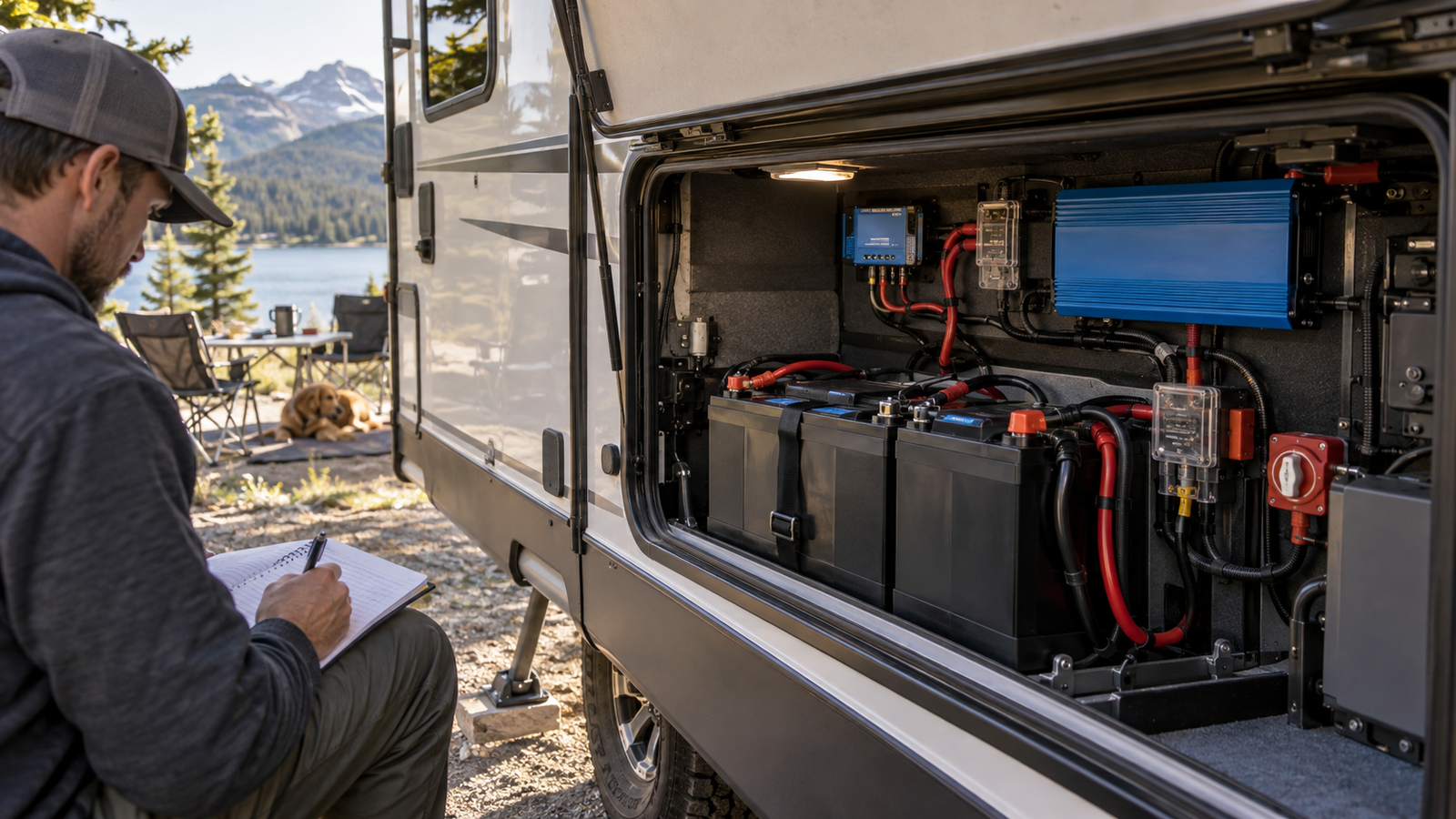
The right LiFePO4 battery for an RV is the one that powers your measured daily loads, supplies your largest simultaneous load, charges correctly from every source and stays within safe temperature and installation limits. Amp-hours alone cannot answer those four questions. A 100Ah battery may run a light 12V system but still be wrong for a high-demand inverter, while a physically large battery can be a poor upgrade if the existing converter, alternator circuit or mounting space does not fit.
This guide uses WattCycle’s U.S. 12V examples to make battery sizing concrete, but the method works for other LiFePO4 suppliers. Product figures cited here are published specifications, not GearInsightWorks bench measurements. We have not inspected or wired these batteries ourselves.
Start with watt-hours, not amp-hours
One amp-hour is a charge quantity; its energy value depends on nominal voltage. For a battery rated at 12.8V, the simple nameplate calculation is 12.8 volts × rated amp-hours = nominal watt-hours. Actual usable energy is lower or different under some temperatures, discharge rates, inverter losses, protective cutoffs and battery conditions.
| Current model example | Published nominal storage | Published continuous discharge BMS | Buyer implication |
|---|---|---|---|
| 12V 100Ah Mini Bluetooth | 12.8V × 100Ah = 1,280Wh | 100A | Compact nominal energy, but high-draw AC appliances can overwhelm the current budget. |
| 12V 314Ah Mini Basic | 12.8V × 314Ah ≈ 4,019Wh | 200A | Roughly 3.14 times the nominal energy of one 100Ah battery, not 3.14 times its current rating. |
Notice the split: the 314Ah battery has about 3.14× the nameplate energy of one 100Ah battery, but the published continuous output current is only 2× as high. A larger energy reservoir does not automatically mean unlimited inverter power.
An RV load worksheet you can reuse
Record power in watts and actual hours of operation per day for each appliance. For cycling appliances, use the motor’s cumulative running hours, not the entire period when it is switched on. Better still, measure with a suitable meter and use the actual model’s manufacturer consumption figures.
| Example device | Assumed average wattage while drawing power | Daily active time | Daily energy |
|---|---|---|---|
| Compressor fridge | 60W | 10h of compressor operation | 600Wh |
| Two fans together | 25W | 8h | 200Wh |
| Lights together | 30W | 4h | 120Wh |
| Laptop charging | 60W | 2h | 120Wh |
| Example total | — | — | 1,040Wh/day |
Illustrative sizing step: Add a user-chosen 20% planning allowance for conversion losses, uncertainty and some reserve. This is an example planning margin, not a guaranteed efficiency or a universal engineering standard: 1,040Wh × 1.20 = 1,248Wh nominal target for one day. A 1,280Wh nameplate 100Ah battery sits barely above that illustrative figure, leaving little additional reserve for unusually hot weather, longer fridge duty, battery aging or a second no-charge day.
For two days without charging, the same simple estimate becomes 1,040Wh × 2 × 1.20 = 2,496Wh. That is nearly the entire 2,560Wh nominal energy of two hypothetical 12.8V 100Ah batteries. It could justify considering a higher-capacity unit such as a 314Ah battery, provided the inverter-current budget, physical fit and system charging checks also pass. Do not infer that a particular series/parallel bank is permitted from arithmetic: the exact manufacturer manual must approve the connection.
Use a separate current calculation for large AC loads
Energy tells you how long the bank might last; current tells you whether a load might trigger the BMS. For an inverter, an illustrative calculation is:
Estimated DC amps ≈ AC load watts ÷ (assumed inverter efficiency × instantaneous DC input voltage).
At an illustrative 12.0V under load and 88% inverter efficiency, a 1,500W AC appliance asks for about 142A of DC current (1,500 ÷ 0.88 ÷ 12.0). This already exceeds the published 100A continuous BMS limit of the 100Ah Mini Bluetooth; the 314Ah Mini Basic lists 200A continuous, but that alone does not establish compatibility with the inverter’s surge, low-voltage draw, other simultaneous loads or wiring. The assumed inverter efficiency and battery voltage in this example were not measured.
Practical rule: make a second list of appliances that may run at the same time. Use their combined starting and continuous requirements and the correct battery variant’s BMS protection curve, along with the inverter documentation. Design the fused cabling and protection for the installation with a qualified RV electrical technician.
The charging compatibility test most RV upgrades miss
An RV is not charged by one device. Before replacing AGM or flooded lead-acid, inventory every possible charge source and whether it has a battery-manufacturer-approved LiFePO4 setting.
| Subsystem | What to verify | Why it changes the purchase |
|---|---|---|
| Shore-power converter/charger | Existing converter model, DC amperage and actual lithium charge profile; compatible replacement if required. | Progressive Dynamics warns that simply increasing replacement-converter current can exceed the capacity of installed RV wiring. |
| Vehicle alternator / house-bank feed | Whether lithium’s charging behavior requires a suitably rated DC-DC charger or alternator-protection arrangement for your vehicle. | Victron’s DC-DC manual describes regulated charging and engine-run detection for applicable installations; alternator output is not an unlimited source. |
| Solar charge controller | LiFePO4 profile, battery nominal voltage, absorption settings, temperature charging lockout and maximum battery charging current. | A solar controller configured for a different chemistry may be unsuitable even if its panel rating sounds sufficient. |
| AC inverter | Surge versus continuous power, low-input-voltage behavior, inverter efficiency and simultaneous DC-current demand. | A capacity upgrade does not bypass BMS continuous-current or protection limits. |
| Cold-weather storage/charging | Whether the exact battery cuts off charging below its published threshold, and if the install requires a self-heating version. | WattCycle’s 100Ah Mini Bluetooth specifications distinguish charge temperature from discharge temperature; do not treat low-temperature discharge advertising as charging approval. |
Safety boundary: Do not reconnect, bypass a BMS cutoff, upsize a charging converter, or alter high-current circuits from an internet checklist alone. Follow the exact battery, converter, vehicle and inverter manuals and use a competent installer when the wiring and protective-device design is uncertain.
100Ah or 314Ah for an RV? Three realistic decisions
Case A: Light weekend camper, minimal inverter use
If the measured consumption genuinely fits within the usable energy of a compact 100Ah battery, the converter supports its charge profile and the biggest appliance stays below its BMS current limit, a specific 100Ah model is the rational first comparison. It is not automatically a weekend guarantee: a power-hungry fridge in high ambient heat or a second no-solar day can change the requirement.
Case B: Longer off-grid stay, several days between charging
If your logged daily watt-hours and required autonomy point toward roughly 4kWh of nominal storage, a 12V 314Ah Mini Basic is a capacity candidate. Check the actual dimensions, battery compartment, weight support, charge time and the model’s 200A continuous BMS rating. Revision matters: WattCycle disclosed two production-process constructions in June 2026. Ask which one you are purchasing rather than assuming a previous review sample matches retail inventory.
Case C: High-power inverter or air-conditioning plans
Do not choose on amp-hours first. Build the maximum simultaneous current budget, include compressor startup behavior, identify battery/inverter voltage requirements and evaluate the complete electrical architecture. A larger or higher-voltage bank designed for that duty may be more appropriate than simply selecting the largest 12V battery from one listing. An installer-supported system and a battery with documented inverter integration can be a more defensible alternative.
The hidden total-cost and failure-mode worksheet
| Line item | Could be needed? | Evidence to collect |
|---|---|---|
| Battery and shipping | Yes | SKU-specific delivered quote and support location. |
| Shore converter replacement | Sometimes | Existing converter model and lithium compatibility. |
| DC-DC alternator charger or protective controls | Sometimes | Vehicle charging architecture and charger input/output ratings. |
| Solar controller reconfiguration/replacement | Sometimes | Manufacturer charge profile and cold-cutoff behavior. |
| Fuse, cable, busbar, disconnect and enclosure work | Installation-dependent | Current/surge budget and code/installation requirements. |
| Installation labor and diagnostics | For uncertain/high-current systems | Written qualified-installation scope and quote. |
The cost of an RV LiFePO4 conversion is the battery plus everything the battery changes. If the existing lead-acid charging system is functioning and the RV is used rarely, keeping a properly maintained AGM bank may be more economical than a partial lithium conversion with hidden rewiring costs. We cannot declare a price winner without your actual bill of materials.
Returns, warranty and after-sale risk
For U.S. purchases, WattCycle’s policy as reviewed October 13, 2026 lists five years for new LiFePO4 batteries, extendable by two years through registration within three months. Its standard return policy generally requires an unused, uninstalled item for a routine 30-day return, with customer-paid return shipping. Installation can therefore change your options. Separately, WattCycle’s special 314Ah production-version statement discusses more generous remedies. Ask for written terms for your actual order if that issue affects the choice.
Even if the battery is covered, account for access to the battery after installation, transport of a heavy unit, time without RV power and who pays replacement labor. Those are practical ownership costs not captured by advertised cycle-life claims.
When WattCycle is worth comparing
If you can demonstrate that the specific WattCycle battery meets your energy, current, charging, temperature, installation and service requirements, it is reasonable to compare it with installer-supported alternatives on delivered cost and documentation. Do not buy merely because a large Ah number promises more nights off-grid. If you cannot verify your existing converter, the correct action is to resolve the RV electrical system first.
Commercial disclosure: We may earn a commission from qualifying purchases or other transactions made through links on this page.
After creating the load and charger checklist, you can compare current WattCycle U.S. battery models. This affiliate destination is the merchant’s homepage; navigate to the exact SKU and confirm the current technical document before purchase.
Seven checks to complete before checkout
- Measure your own watt-hours per day; do not rely on a generic camping-runtime chart.
- Select the required number of no-charge days and state your reserve assumptions.
- Confirm worst-case inverter DC draw, startup surge and the battery’s continuous BMS limit.
- Identify every converter, DC-DC, solar and alternator charging path and its LiFePO4 settings.
- Verify cold-weather charge cutoff, mounting orientation, ventilation/clearance requirements, footprint and cable/fuse plan.
- For 314Ah Mini Basic purchases, verify construction version and documented warranty/return terms.
- Have a qualified RV electrician sign off where wiring, current protection or installation standards are uncertain.
The decision rule: Size from daily Wh and no-charge autonomy, disqualify batteries that fail peak and continuous current, then confirm all charge-source and mechanical interfaces. That order catches far more costly errors than comparing advertised capacity alone.
Source/freshness note: Model-specific U.S. merchant specifications, converter/charger manuals and policies examined October 13, 2026. The load worksheet and current calculation use stated hypothetical assumptions, not independently measured battery performance or a certified electrical design. Local installation requirements and equipment documentation govern.