
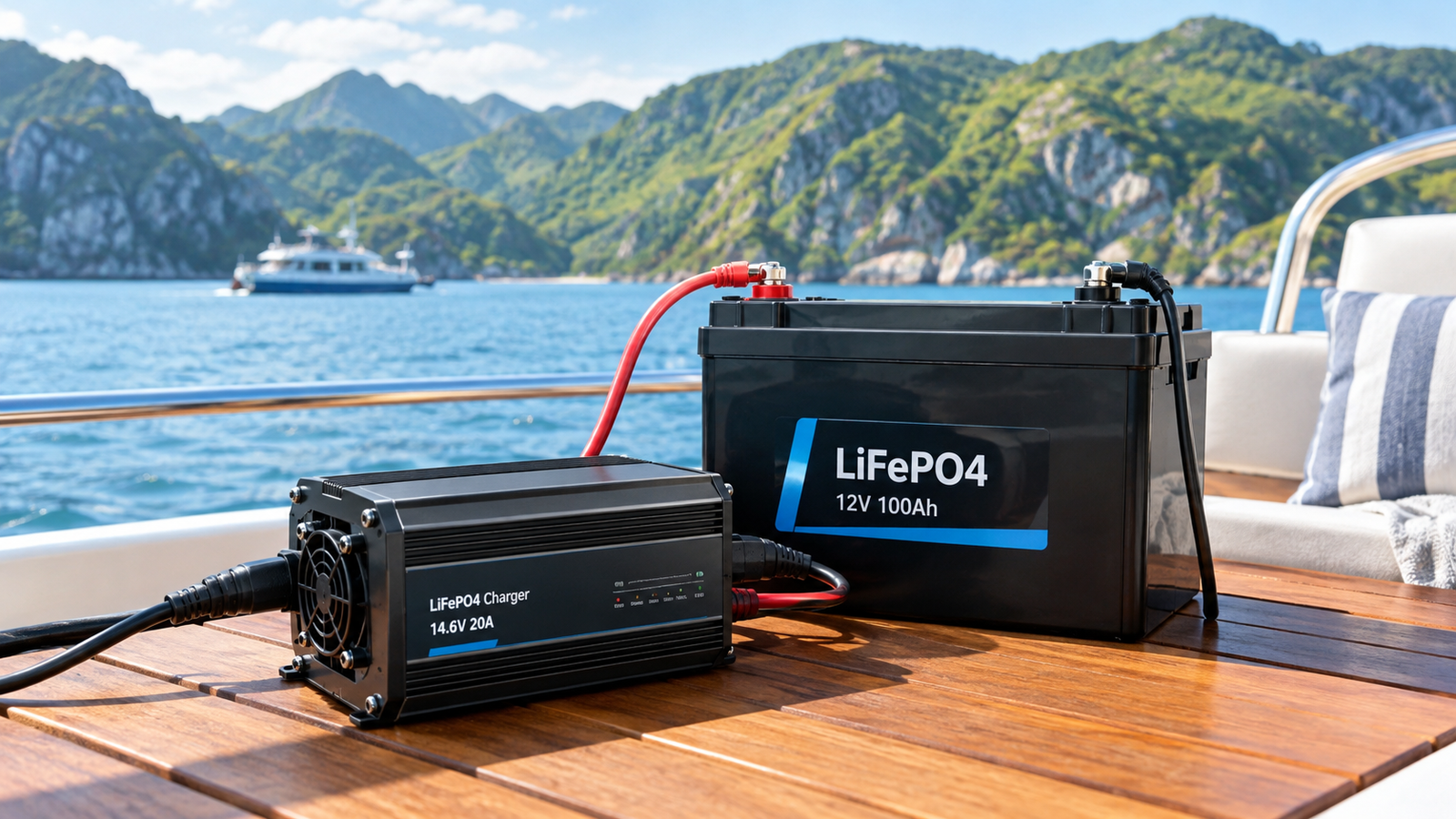
Short answer: The right LiFePO4 battery charger is the one whose charging voltage, current limit, charge algorithm, temperature handling and physical connections are explicitly permitted for your exact battery model. A charger advertised as “12V lithium” is not automatically suitable for every 12V pack. Check the battery manual first, then match the charger—not the other way around.
This is a U.S.-market, documentation-based guide covering portable AC-to-DC charging and the decisions that distinguish it from RV alternator and solar charging. WattCycle models are examples, not a universal compatibility list. No battery or charger was bench-tested by GearInsightWorks. Product documentation and manufacturer settings were checked on October 13, 2026.
A five-check method that prevents the expensive mistakes
| Check | What must match | Consequence of guessing |
|---|---|---|
| 1. Battery and charger voltage | The actual charge-voltage requirement of the 12V, 24V, 36V or 48V LiFePO4 pack—not simply the nominal system label | Undercharging, BMS cutoff or overvoltage risk |
| 2. Charge algorithm | Approved constant-current/constant-voltage (CC/CV) setpoints, termination and any float/storage behavior | An AGM/equalization/recondition program can be inappropriate |
| 3. Current limit | Battery’s recommended and maximum charging amperes, applicable BMS and wiring/connector limits | Tripped protection, excessive heat or unnecessary charger expense |
| 4. Charging temperature | Cell/battery temperature, not merely the room temperature or the charger’s own operating range | Charging a cold lithium pack when its instructions prohibit it |
| 5. Physical and power-input fit | AC input voltage, correct plug, charger leads/terminals, cable length and ventilation | An incompatible mains supply or an unsuitable lead and installation |
Battery manufacturer documentation, rather than the word “smart” on a box, establishes the acceptable profile. The Victron lithium-battery operation manual independently reinforces the need to match charger voltage, current and lithium charge parameters. A separate battery maker may prescribe different setpoints: that is precisely why a generic preset is not universal.
14.6V, 29.2V and 58.4V: charger output is not the same as battery nominal voltage
A 12.8V nominal LiFePO4 battery is often charged at a higher voltage. For example, WattCycle lists 14.6V ± 0.2V CC/CV for its U.S. 12V 100Ah Mini Bluetooth battery. That is a battery-specific requirement, not a command to set all 12V lithium chargers to 14.6V. Victron’s Blue Smart IP22 120V manual, by contrast, lists 14.2V absorption in its integrated 12V Li-ion mode. The two numbers come from different manufacturers’ products; neither is an independent approval of the other.
| Specific charger | Published output | Published AC input | What to verify |
|---|---|---|---|
| Aluminum-shell 12V 20A (WT-15V20AFA) | 14.6V / 20A | 100–240V, 50/60Hz | 12V battery’s allowed voltage; supplied connection leads |
| Aluminum-shell 12V 40A | 14.6V / 40A | 90–130V, 50/60Hz | Whether battery accepts 40A and whether this specific AC-input version suits your supply |
| Aluminum-shell 24V 15A | 29.2V / 15A | 100–120V, 50/60Hz | True 24V LiFePO4 configuration, not two unspecified 12V batteries |
| Aluminum-shell 48V 15A | 58.4V / 15A | 100–240V, 50/60Hz | Battery’s 48V profile and connector; this is not a 12V battery charger |
Important variant trap: The 20A and 40A 12V chargers do not have identical advertised mains-input ranges. The 40A’s listed 90–130V is not an all-country travel charger. The WattCycle manual-download index gives a separate 36V/48V charger manual, while the 48V 15A product listing was observed displaying a 14.6V/20A manual label. Treat that document-link mismatch as a reason to request the correct model-specific manual in writing, not as proof that the shipped charger is wrong.
How many charging amps do you actually need?
“Faster” is valuable only if both battery and installation allow it. The 12V 100Ah Mini Bluetooth listing gives a recommended 20A (0.2C) charge current and a 100A maximum continuous charging current. Those are not interchangeable: the recommended current is the manufacturer’s routine-use preference, while the maximum is a ceiling, not evidence that faster charging is always better. See the exact battery charge specifications.
At 100Ah, 20A corresponds to 0.2C; 40A is 0.4C. A practical decision uses three limits: the battery’s manufacturer recommendation, its maximum/BMS limit, and the lowest-rated lead or charging component. Never infer that a battery with a 100A discharge BMS also permits 100A charging; the values must be checked separately.
| Charger | Arithmetic | Ideal constant-current minimum | Why actual time differs |
|---|---|---|---|
| 20A | 80Ah ÷ 20A | 4.0 hours | Voltage regulation/taper, BMS limits, temperature and charger overhead |
| 40A | 80Ah ÷ 40A | 2.0 hours | Only meaningful if this battery, leads and AC source can accept the higher rate |
| 15A | 80Ah ÷ 15A | 5.3 hours | Battery-bank size and actual remaining Ah still govern total time |
These figures deliberately ignore the slower constant-voltage stage and therefore are lower-bound arithmetic examples, not charge-time promises. For a battery whose exact charge current is unknown, even this worksheet is not a permission to choose the largest available charger. A controller’s lithium preset and the manufacturer’s battery charge specification must agree.
Charge profile: why “AGM mode is close enough” can fail
A lithium charger should be able to deliver an approved CC/CV voltage/current sequence and stop or maintain the battery as instructed. The Victron Blue Smart 120V manual illustrates a real design distinction: its Li-ion setting is 14.2V absorption for 12V systems, while “High + Recondition” for lead-acid uses a different charging program and higher recondition voltage. Do not use a lead-acid recondition, desulfation or equalization function on a LiFePO4 battery unless the exact manufacturer explicitly authorizes it.
The Victron SmartSolar manual disables equalization in its LiFePO4 profile and warns against applying unsuitable equalization to batteries. It also disables temperature-based voltage compensation under that lithium profile. These examples explain the kind of algorithm change a correct charger makes; they do not turn its particular setpoints into universal standards.
With WattCycle, check whether a particular charger is fixed-output or user-configurable, and check the exact battery’s permitted charge voltage. If a configurable third-party charger cannot reproduce an acceptable charging window, choose a documented compatible option rather than assuming that a lithium-labeled menu setting is enough.
Temperature protection belongs to the battery, not a marketing promise
The WattCycle 12V 100Ah Mini Bluetooth specifications list a battery charging range of 0–50°C (32–122°F) and a low-temperature charging cutoff that is described as recovering at 5°C (41°F). An AC charger’s operating-temperature range describes the charger, not the cell temperature. The product’s own BMS may block charging even while its attached charger shows power available. Read the battery’s low-temperature specification; it is not safe to extrapolate that threshold to all WattCycle revisions or self-heating models.
The Blue Smart IP22 manual likewise warns against charging a lithium-ion pack below 0°C in its described application. A battery’s temperature sensor and BMS policy must be respected rather than bypassed. A pack with a heating option requires its own manual: “self-heating” does not itself establish when the heater starts, how it is powered, or how much charging energy it consumes.
Which charger type solves your actual problem?
| Situation | Appropriate device category | Additional compatibility condition |
|---|---|---|
| Recharge a removed battery at a shore outlet or workshop | Battery-specific AC-to-DC charger | AC input, correct lithium mode, DC leads and ventilation |
| Recharge a leisure bank while a vehicle engine runs | Correctly designed alternator-to-house-battery DC-DC charger | Vehicle alternator behavior, current limiting, isolator design and wiring |
| Recharge from solar panels | LiFePO4-configured MPPT solar charge controller | PV input voltage/current, battery algorithm, low-temperature blocking and panel sizing |
| Charge a multi-module 51.2V rack bank from an inverter/charger | Inverter/charger with validated battery profile and any required BMS communications | Rack/inverter voltage window, bank-current limit and documented control logic |
For a vehicle system, the Victron Orion-Tr Smart DC-DC manual explains why alternator-charging equipment has its own current-limiting and engine-related design considerations. For solar, the SmartSolar MPPT manual documents battery-specific settings. Buying a wall-plug battery charger does not by itself modernize the RV converter, alternator circuit or solar regulator.
Likewise, a multi-bank charger is not automatically approved for charging series-connected lithium batteries as isolated packs. Each bank’s isolation, charger-manufacturer instructions and the battery manufacturer’s series-configuration policy must be established before use.
When a charger refuses to start, diagnose the reason before replacing it
- Check the simplest electrical facts: selected mains/input range, the status LEDs described in the model’s current manual, battery voltage and physical connector condition. Do not open the charger’s enclosure.
- Check the battery condition: excessively low voltage, a tripped BMS, temperature outside the permitted charging range, or a disabled charge path can stop the charge. The battery’s precise reset or wake procedure is model-specific.
- Separate a protection state from a bad charger: WattCycle’s 40A/60A/80A charger manual lists distinct flashing indications for abnormal operating states; flashing is not always proof of a defective unit.
- Stop with damaged or unclear equipment: burning odor, swelling, damaged wiring, repeated trips or unsupported charger/battery voltage require disconnection and qualified help rather than experimental overrides.
Some lithium chargers can recover certain under-voltage protection states; others cannot. That feature must be supported by the specific battery and charger, not assumed from another model’s app or review. Never use uncontrolled high-voltage sources or defeat temperature protection to wake a pack.
Where WattCycle fits—and where another charger makes more sense
WattCycle’s 14.6V/20A charger is a logical candidate for a 12V pack that explicitly permits 14.6V charging around 20A; the WattCycle 100Ah Mini Bluetooth is one such documented example. Before purchase, confirm the ordered battery revision, terminals and charger input, and obtain the exact accessories list. A higher-output fixed charger is only attractive when the battery’s recommended/max charge current and the entire electrical path support it.
A configurable multi-chemistry charger such as a Victron Blue Smart IP22 may be preferable if you need documented settings, adjustable current and a consistent maintenance workflow across multiple compatible battery types. But its built-in Li-ion preset is not automatically verified against a WattCycle battery specifying 14.6V ± 0.2V; confirm an approved custom setting or written manufacturer guidance first. If you want an all-in-one RV or inverter charger, shop for that device class rather than a loose AC battery charger.
Commercial disclosure: We may earn a commission from qualifying purchases or other transactions made through links on this page.
If your manual and charging-system checklist agree, you can compare WattCycle chargers and batteries at the official U.S. store. This link opens the merchant homepage, not a verified model-specific charger destination; confirm current compatibility, stock and accessories on the final product listing.
Buyer checklist: save these answers with the order
- Battery nameplate, SKU, nominal system voltage, revision and current user manual.
- Permitted CC/CV absorption/termination and float behavior; whether lead-acid recondition/equalization is prohibited.
- Recommended charge current, absolute max charging amps, BMS charge limit and bank configuration.
- Temperature limits and whether a heating/cutoff feature requires additional wiring or energy.
- Charger model, exact AC input rating, included plug and DC connector style; approved ventilation location.
- What happens on a BMS trip or power outage; how to restart without bypassing protection.
- Charger-specific warranty, return terms and a dated copy of specs; accessories commonly have different coverage from batteries.
Bottom line: Match battery documentation before buying charge speed. For a 12V WattCycle 100Ah Mini Bluetooth, 14.6V/20A is a documented manufacturer-aligned starting point; it is not a prescription for an arbitrary 12V LiFePO4 battery. Different voltage classes, current ratings and even AC-input versions change the answer.
Sources and scope: Documentation checked October 13, 2026. Linked material includes WattCycle U.S. model pages and manuals and Victron battery/charger instructions. Manufacturer specifications are published ratings, not GearInsightWorks measurements. Confirm exact shipped model and locally applicable electrical requirements with qualified personnel before installation.