
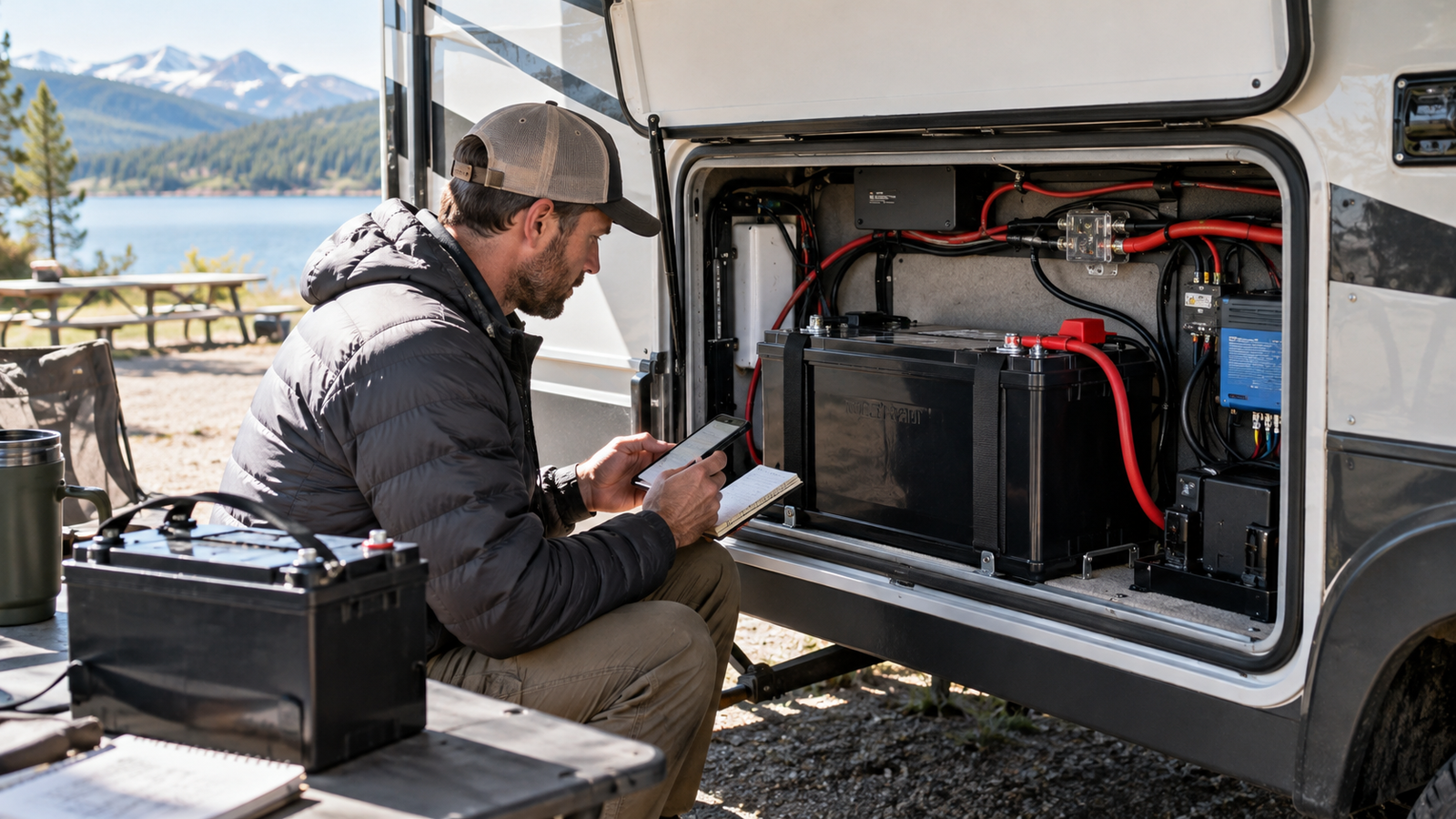
Short answer: WattCycle is worth considering when its specific battery fits your charging equipment, continuous load and service expectations. It is not a brand we would buy solely on an advertised amp-hour number. The most consequential issue is traceability: in June 2026, WattCycle confirmed that two internal-wiring production versions of its 12V 314Ah Mini Basic were on the market. That is a reason to establish the exact revision before ordering, not evidence that every WattCycle battery is faulty.
This WattCycle battery review is a documentation- and third-party-evidence assessment, not a GearInsightWorks hands-on test. It is aimed at U.S. buyers comparing 12V LiFePO4 batteries for RV, marine house loads or off-grid equipment. WattCycle has several product families; observations about one SKU do not transfer automatically to another.
Commercial disclosure: We may earn a commission from qualifying purchases or other transactions made through links on this page.
The decision in 60 seconds
| Your situation | Reasonable next step | What would make us walk away |
|---|---|---|
| Light 12V electronics, moderate loads | Compare a specific 100Ah model’s 100A continuous BMS, footprint and charger requirements. | A converter with an incompatible charge profile or no low-temperature charging plan. |
| High-energy RV house bank | Evaluate 314Ah nominal energy against the actual inverter current, mounting space and revision history. | A load needing more than the model’s permitted continuous current, or an unclear shipped hardware version. |
| Want app telemetry or balancing features | Identify the precise Bluetooth or Super SKU rather than assuming the Basic includes the same features. | A listing mixing model names, BMS ratings or screenshots across versions. |
| Marine propulsion or engine start | Use a purpose-matched trolling or explicitly rated starter model, and check the motor maker’s instructions. | Using a house battery’s amp-hour rating as proof of engine-cranking suitability. |
First identify which WattCycle battery is actually being reviewed
“WattCycle 12V battery” is not a single electrical specification. The seller’s current U.S. pages list the following materially different examples. Figures below are manufacturer-published nominal ratings, not our test results. Confirm the exact SKU and current revision on the listing and packaging.
| Model named on listing | Nominal energy | Published continuous BMS discharge | Why it differs |
|---|---|---|---|
| 12V 100Ah Mini Bluetooth | 12.8V × 100Ah = 1,280Wh | 100A | Lower-capacity compact choice; Bluetooth monitoring on this version. |
| 12V 314Ah Mini Basic | 12.8V × 314Ah ≈ 4,019Wh | 200A | More stored energy but a specific 200A discharge ceiling and documented wiring revisions. |
| 12V 314Ah Mini Super | 12.8V × 314Ah ≈ 4,019Wh | 200A | Seller advertises Bluetooth and a 3A active-balancing system; not proof of better field reliability. |
Nominal watt-hours answer how much energy is stored. A BMS continuous-current rating helps answer how much electrical load the battery can sustain. Neither guarantees the advertised energy is available at every temperature, voltage or discharge rate. Comparing a 314Ah battery against three 100Ah batteries without the BMS limits, charge equipment and wiring context can therefore produce the wrong answer.
What happened with the 314Ah Mini Basic wiring?
In a June 16, 2026 statement, WattCycle acknowledged two production-process versions of its 12V 314Ah Mini Basic: an older construction using stranded-copper BMS conductors and an updated one using flat braided copper conductors. WattCycle characterizes the new layout as an assembly-consistency improvement, while asserting both versions meet its tests. The company’s statements about test equivalence are manufacturer claims; they are not independent certification of both populations.
The disclosure followed an independent review controversy. A June 9, 2026 Hackaday report describes teardown-based concerns about differences between review and retail units and reported conductor voltage-drop differences. That report is secondary coverage of testing, not our own teardown or a controlled failure-rate study. The direction and significance of differences should not be generalized to every WattCycle battery—or used to claim a proven fire hazard.
Four questions that matter more than an old review score
- Which construction will be shipped? Ask WattCycle to identify the 314Ah Mini Basic revision/production batch for the exact stock you would receive and whether the improved conductor layout is included.
- Does your requested load fit the confirmed revision? Obtain the current datasheet and the continuous BMS and temperature limits for that specific model, not a screenshot from a different 314Ah line.
- Which test reflects the product you can buy? Give more weight to testing with a purchase date and documented internals than to an unidentified review sample; absence of a repeatable test is an uncertainty, not proof of failure.
- What remedy is written into your order? Keep any revision, warranty or return assurance in writing before installing the battery.
Our reading: WattCycle’s admission improves transparency about the existence of different constructions, but it also makes an old unqualified “WattCycle 314Ah review” less useful. Until a buyer can identify shipped stock, we would not make a blanket reliability recommendation for the 314Ah Mini Basic.
What does independent testing actually establish?
There is some independent measured evidence for earlier, different models. In a December 2024 Panbo review, updated January 2025, Ben Stein reports testing two earlier 12V 100Ah Group 24 Bluetooth batteries and measuring about 101.75Ah from a capacity test. Panbo also discusses the construction and BMS behavior it observed. That is a useful counterweight to marketing, but it is not a validation of a 2026 314Ah Mini Basic, a Mini Super, or a dedicated trolling-motor model.
Likewise, WattCycle publishes its own thermal-test response concerning an older 314Ah conductor configuration. Reported test temperatures or claims of passing internal checks cannot establish reliability across years, revisions, vibration environments or installation mistakes. Ask for the exact revision and, if safety certification is a purchase condition, the model-specific documentation—not just an accreditation logo.
The 200A BMS is a real design constraint, not a 200A promise at every moment
For the 12V 314Ah Mini Basic, WattCycle lists a 200A maximum continuous discharge current. At the 12.8V nominal voltage, a simple multiplication gives 2,560W of nominal DC input power. Real inverter current changes as battery voltage falls and power-conversion losses accrue.
For example, a hypothetical 2,000W AC appliance supplied through an 88%-efficient inverter from a battery at 12.0V would draw approximately 2,000 ÷ (0.88 × 12.0) = 189A on the DC side, before other house loads or startup surge. The 200A rating leaves little current margin. A 3,000W inverter’s advertised capacity is not evidence that one 200A battery can sustain a 3,000W AC load. Confirm inverter surge, low-voltage behavior, protective devices, wiring and temperature constraints with a qualified installer.
Charging, cold weather and installation: where “drop-in” can fail
On its 100Ah Mini Bluetooth page, WattCycle specifies a LiFePO4 charge-voltage target around 14.6V and temperature-related charging protection. Do not transfer that exact charging range or BMS recovery behavior to every other WattCycle model. A cold-temperature discharge capability does not mean the battery may be charged below freezing.
An RV adds converter, alternator/DC-DC, solar-controller and inverter considerations. Progressive Dynamics’ lithium conversion guidance explicitly calls for identifying the existing converter and warns that replacing it with a higher-output unit without verifying wiring capacity can be unsafe. The Victron DC-DC charger documentation explains why alternator-to-lithium charging needs controlled current in applicable setups. These are system checks, not claims that WattCycle batteries are incompatible with particular converters.
Warranty is not the same as a no-questions return
WattCycle’s published warranty policy, checked October 13, 2026, lists a five-year base warranty for new LiFePO4 batteries and two additional years if registered within three months of purchase. It lists conditions and exclusions; the stated term does not establish friction-free replacement for every problem.
Its return policy says routine returns within 30 days require an unused, uninstalled product, plus packaging and proof of purchase. This should not be read as a free trial after wiring a battery into an RV. There is also a meaningful policy discrepancy: the June 2026 314Ah statement discusses a more generous return remedy for affected units. Because a public general policy and a product-specific statement differ, request written, order-specific terms—especially if the construction version is why you might return it.
When would we buy WattCycle, and when would we choose an alternative?
| Condition | Decision |
|---|---|
| A named SKU has the right voltage, continuous BMS output, documented charge limits, space and warranty terms. | Consider WattCycle. The manufacturer-published spec can be evaluated against a real load plan; still verify shipment revision. |
| Critical equipment depends on a precise construction or third-party verification of the current shipped lot. | Defer the purchase until revision-specific documentation or comparable independently tested current stock is available. |
| The RV converter, alternator charging arrangement or winter storage plan cannot support lithium charging requirements. | Fix the system design first or retain an appropriate existing AGM setup rather than force a drop-in replacement. |
| Domestic support, installation or documented marine-system compatibility outrank initial battery price. | Compare an installer-supported battery system with published installation specifications and written support terms. No brand-level winner can be established without matched SKUs and comparable evidence. |
For buyers who have already checked the electrical requirements, browse WattCycle’s current U.S. battery lineup and match the model name on the product page to the seller’s current datasheet. This link goes to the merchant’s homepage, not a verified model-specific checkout page.
Pre-purchase verification checklist
- Record the exact SKU, BMS amperage, nominal voltage, case dimensions and current manual version.
- For a 314Ah Mini Basic, request written identification of shipped production construction and any applicable remedy.
- Calculate both daily watt-hours and worst-case simultaneous DC amperage; check inverter surge behavior.
- Verify charge voltage, continuous charging amps, all charging sources, freezing-temperature logic, fuse and cable design.
- Check U.S. shipping destination, terms of registration, date-limited return conditions and who pays shipping.
- Save the product page, terms, invoice and the seller’s answers with the order date.
Bottom line: A defensible WattCycle purchase is model-specific and system-specific. Independent evidence for one historical 100Ah battery, a manufacturer test for an older 314Ah build and a current product listing answer three different questions. Bring those together carefully, but do not mistake them for a universal WattCycle reliability rating.
Source and scope note: U.S. merchant pages and third-party reports examined October 13, 2026. Nominal ratings are manufacturer claims. Calculations are illustrative, not testing, design approval or an installation procedure. Prices, revisions, stock and policies may change.