
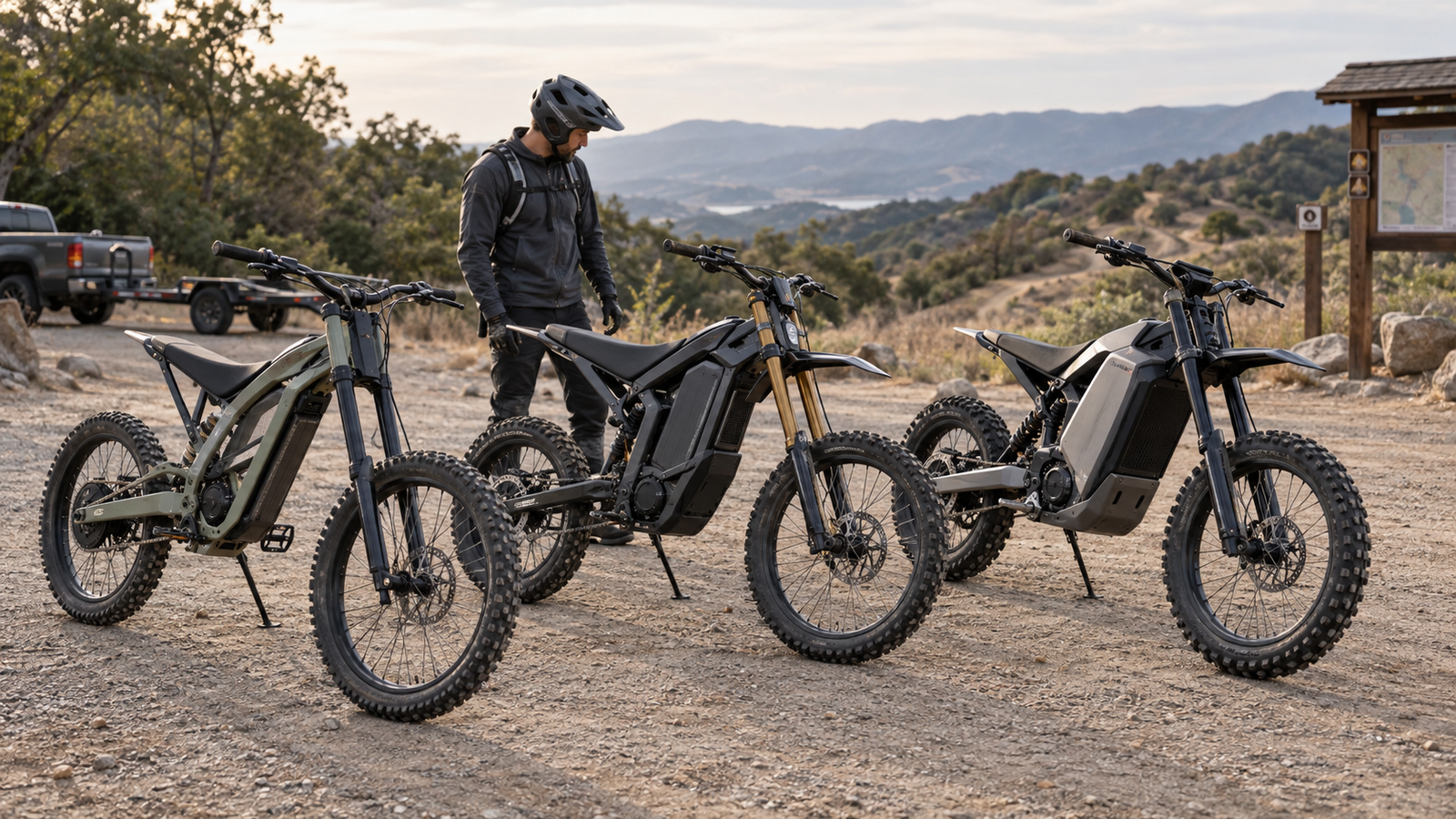
Short answer: The best Surron alternative depends on what you are trying to replace: the Light Bee’s light-motorcycle chassis and mid-mounted drive, its local service and parts pathway, or simply its price. A cheaper, powerful-looking hub-motor bike may be a useful recreational substitute but is not mechanically equivalent. For U.S. buyers comparing current models in October 2026, the EKX X21 Max and Freego X2 Pro sit in the lower-price discussion; Talaria XXX Pro is closer in mid-motor architecture; E Ride Pro PRO-S and SS 3.0 are higher-price power/fit alternatives.
Commercial disclosure: We may earn a commission from qualifying purchases or other transactions made through links on this page.
Which Surron? The baseline changed by model year
Comparisons that simply say “versus a Surron” are too imprecise. The 2026 North American Light Bee X described by a current retailer has a 72 V 35 Ah pack (2,520 Wh nominal by multiplication), 10 kW claimed peak output, roughly 130 lb curb weight, and a primary belt plus secondary chain transmission. A regional Surron distributor contrasts that with an earlier 2025 Light Bee X configuration generally discussed as 60 V and 8 kW. These are dealer/distributor-listed specifications, not results of GearInsightWorks instrumented testing. Neither local dealer availability nor an all-in U.S. transaction price can be inferred from the retailer’s generic listing (2026 Light Bee X seller specifications; 2025-versus-2026 distributor summary).
That version difference matters in both directions. Do not call an 8 kW alternative “equal to Surron” using an older baseline while advertising a 2026 10 kW machine. And do not assume a 72 V label automatically wins over a 60 V motor system: battery capacity, power delivery, controller limits, gearing and rider load are distinct dimensions.
Five Surron alternatives, five different compromises
All prices below are observed U.S. seller entry listings as of October 13, 2026, subject to variants, availability and shipping. Wh values are nominal arithmetic, not independent usable-capacity or range measurements. Source links within the model names lead to each inspected listing.
| Candidate | Listed entry price | Seller-claimed peak power / nominal pack | Drive/layout evidence | Main compromise against the 2026 Light Bee X |
|---|---|---|---|---|
| EKX X21 Max (8 kW current variant) | From $1,949; configurations above $2,000 exist | 8 kW; 60 V × 30 Ah = 1,800 Wh | Hub-motor positioning in EKX range; 7-speed human pedal drivetrain | Less nominal battery energy, different motor-to-wheel architecture; support and exact variant must be validated |
| Freego X2 Pro | From $2,199; stock page conflicts | 6 kW; 60 V × 30 Ah = 1,800 Wh base, 40 Ah option 2,400 Wh | 3 kW nominal rear hub; single-speed pedal drivetrain | Different wheel/motor dynamics; ambiguous live stock and service experience |
| Talaria XXX Pro | $3,750 at Luna Cycle | Dealer lists 60 V 40 Ah maximum pack capacity (~2,400 Wh nominal max-label arithmetic); separate rated capacity lower | Mid-mounted IPM motor, belt reduction; optional pedal kit | More architectural similarity, but a different chassis/geometry and dealer-service equation |
| E Ride Pro PRO-S | $3,999 + $300 shipping listed | 8 kW; 72 V × 30 Ah = 2,160 Wh | Compact 16- or 17-inch wheel variants; 31.2-inch seat claim | Higher cost; compact fit and suspension/terrain expectations need checking |
| E Ride Pro SS 3.0 | $4,699 + $300 shipping listed | 15.8 kW; 72 V × 50 Ah = 3,600 Wh | Heavier e-moto class; seller lists ~167 lb | Higher claimed output and energy, but major weight and cost penalties |
Reference baseline: The 2026 Light Bee X seller lists 10 kW, 72 V 35 Ah/2,520 Wh, around 130 lb, and belt-to-chain drive. The Talaria nominal capacity line uses a seller maximum figure, so no claim is made that its usable energy matches the 2026 Light Bee X. All peak-power and marketing-range numbers in this table lack a common dynamometer, traction or rider test protocol and should not be ranked numerically.
Why the $1,949 X21 Max is a candidate—not a $1,949 Surron clone
The EKX X21 Max’s appeal is the large visible difference in checkout entry price. Its checked current listing advertises 3 kW rated and 8 kW peak from a 60 V 30 Ah battery and describes a seven-speed pedal drivetrain. That may satisfy an adult who rides permitted recreational routes and prioritizes lower initial cost. Yet the nominal pack has about 720 Wh less label energy than the 2026 Surron benchmark (2,520 − 1,800), and its hub-oriented drivetrain is a different engineering starting point. The arithmetic does not measure usable range or heat performance (EKX X21 Max product; 2026 Light Bee X seller specification).
There is a further credibility check: current EKX comparison material conflicts on the X21 Max’s weight, listing around 48.2 kg in one place and 53 kg in another. Weight affects loading, transport, turning effort and bike recovery after a fall. Get the exact model-year, as-shipped curb weight and tire/brake configuration before treating a photo or a headline watt number as equivalent to a Light Bee. This is a seller-document inconsistency, not proof either figure is correct (X21 Max specification block; EKX internal comparison).
Just as important, the EKX warranty process distinguishes covered parts from costs such as installation and possibly parts freight; the FAQ and return page do not present a perfectly aligned trial-and-return proposition. A local service shop or stronger after-sales assurance could outweigh a large price difference if you cannot diagnose electrical faults yourself.
Freego X2 Pro: a different low-cost hub-motor trade
At its inspected U.S. listing, the X2 Pro has a rear hub motor rated at 3 kW nominal/6 kW peak and a claimed 60 V 30 Ah or 40 Ah battery choice. The 40 Ah option has 600 Wh more label energy than the base battery; it needs its own checkout price. Freego lists a 32.3-inch seat, 19-inch wheels, four-piston hydraulic brakes and 203 mm rotors. These are useful purchase specifications, not a matched comparison proving equal suspension, braking or thermal behavior to the Surron (X2 Pro specification and geometry).
There are two material caution flags. First, the official store page simultaneously says “Sold out” and “In stock & Ready to ship,” so stock for the selected battery configuration is unresolved. Second, public owner reports include electrical diagnosis and support difficulties while other owners describe satisfactory use or support. These are individual, self-selected experiences—not a verified defect frequency. For a non-mechanically inclined buyer, ask who will repair it locally and whether a replacement controller or brake part is stocked domestically.
Talaria XXX Pro: closer powertrain concept, not automatically a perfect Light Bee replacement
Luna Cycle currently lists the XXX Pro at $3,750 with a mid-mounted IPM motor and belt reduction, compared with the Light Bee X seller’s primary belt and secondary chain layout. A motor mounted nearer the sprung chassis instead of inside a wheel changes unsprung-mass and service trade-offs; it does not independently prove better traction, lap time or component reliability. Talaria has a visible dealer parts catalog, but catalog visibility alone cannot guarantee parts for every year or local technician coverage (XXX Pro drive, geometry and dealer details).
The trade-offs still need a fit test: dealer-listed 31.5-inch seat height, 125 lb mass and its stated rear suspension specification may suit a different rider than a 2026 Light Bee X with the seller-listed 32.7-inch seat and about 130 lb curb weight. Those values cannot replace sitting on both bikes. The XXX Pro’s optional $300 pedal kit also carries a clear dealer warning: pedals do not make the bike an e-bike or road-legal vehicle. Select it for the off-road architecture and verified fit, not a hoped-for loophole (Luna Cycle sales and off-road notice).
E Ride Pro: compact technical fit versus more energy and mass
The E Ride Pro PRO-S is a useful alternative when a buyer wants an approximately 31.2-inch seat height and 16-/17-inch wheel selection, subject to fit and terrain, and can absorb the official $3,999 price plus $300 stated shipping. Its maker lists 8 kW peak and 72 V 30 Ah/2,160 Wh, with 127 lb unit weight. The heavier SS 3.0 is a different decision: $4,699 plus $300 shipping, 72 V 50 Ah/3,600 Wh label energy, 15.8 kW peak and about 167 lb. Neither number makes it automatically better for a novice or a rider who must lift a disabled bike into a truck. These are specific, current PRO-S and SS 3.0 manufacturer claims; no comparative instrumented course test was established.
Four engineering questions matter more than the peak-watt race
1. Where is the motor’s mass?
A hub drive puts the traction motor within the wheel assembly; a mid-mounted motor drives the wheel through a separate reduction/transmission path. In general that changes unsprung-mass, gear-ratio options and repair exposure, but real handling also depends on suspension tuning, wheel construction, tires, rider and terrain. On repeated sharp impacts or technical climbs, inspect the actual rear suspension and motor mounting before treating a budget hub bike as a one-for-one replacement. Avoid categorical claims such as “all hubs overheat” or “mid drives always climb better”; no product-specific thermal tests here justify them.
2. What does the battery label predict?
Nominal watt-hours come from voltage × amp-hours. They help compare stated energy storage if the labels are accurate, but do not show usable state-of-charge window, controller efficiency, degradation, road speed, charging losses or range under the same route. For example, an 1,800 Wh pack is about 71% of the Light Bee X’s 2,520 Wh label, but that is not a prediction of 71% of its riding distance. Compare actual independent ride logs with rider weight, temperature, terrain and speed controls if range is the deciding factor.
3. Can the bike be kept running without specialist delays?
Do not compare only advertised warranty length. Request a parts list for brake pads, rotors, tires, wheel assemblies, swingarm bearings, throttle, controller, battery/BMS, charger, belt or chain and motor; ask a repair shop whether it will work on your exact brand, voltage and model. The presence of EKX parts and Talaria dealer parts online is a useful starting signal, not a service-level agreement.
4. Can you ride it where you intend?
None of these powerful off-road choices becomes a Class 1–3 e-bike solely through pedals or a speed-restricting dashboard setting. For federally managed BLM land, BLM defines an e-bike motor ceiling of 750 W and class-specific assistance limits; vehicles exceeding its categories are managed as OHVs. State highways, city paths, forest routes and private facilities can be subject to different additional rules. Confirm the route, rider age, helmet/equipment, licensing and registration requirements before counting on any purchase. An authorized motorized OHV area is a different destination from a nonmotorized bicycle trail.
Decision tree: which alternative should you investigate first?
| Highest priority | Start here | Rule out immediately if… |
|---|---|---|
| Lowest purchase price with permitted recreational riding | EKX X21 Max or lower-priced EKX TX1, with whole-bike and service checks | You need a proven local parts/repair network or nonmotorized-trail eligibility |
| Pedal-equipped hub bike and more nominal pack options | Freego X2 Pro 30/40 Ah variants | The exact SKU is unavailable or warranty diagnostics must be done by the owner |
| Mid-mounted drive and dealer-accessible parts discussion | Talaria XXX Pro | Seat/weight/wheel geometry does not fit or the dealer cannot service your ZIP code |
| Lower seat and compact wheel configuration at a higher price | E Ride Pro PRO-S | You require a larger platform/pack or cannot afford stated freight and ownership extras |
| Larger nominal battery and greater claimed peak output | E Ride Pro SS 3.0 | Extra mass or premium cost undermines handling, transport or safety needs |
A buyer with access to a reputable local Surron dealer, fit that works and appropriate budget may reasonably prefer the actual Light Bee X rather than any substitute. The point of a Surron alternative is to solve a concrete constraint, not to prove that every less expensive machine is an identical platform.
Before spending money, insist on seven comparable answers
- Which exact year/market is the comparison against—2025 Light Bee X, 2026 North American Light Bee X, or another Surron?
- Which as-shipped motor location, gear reduction, nominal/peak rating and battery SKU does the candidate have?
- Can the dealer supply actual curb weight, seat height and loaded suspension sag for your rider mass?
- Where is the authorized riding location, and what motor-vehicle or land-use rules apply?
- What are the out-the-door and first-season costs, including shipping, protective gear, transport, tires, brake pads and repairs?
- Who diagnoses and replaces a failed controller, charger or battery, and who pays parts freight and labor?
- What independent, comparable range/heat/braking evidence exists under your rider weight, terrain and mode? If none, reduce confidence rather than inventing a result.
Our conditional conclusion: The X21 Max deserves a shortlist for a price-sensitive rider with legitimate motorized riding access and DIY/service tolerance, not for someone expecting the same drive architecture and dealer experience as a Surron. The Talaria is the more relevant mid-motor technical comparison; the PRO-S offers a specific fit-oriented purchase route; the SS 3.0 answers a different, higher-power/weight decision. There is no independently established outright winner here.
For the EKX-specific option, you can review the current EKX range and request an exact X21 Max quote. This is the provided affiliate homepage link—not a verified product deep link. Check the return policy, model identity and where you will ride before purchasing.
Research boundary: U.S. products, dealer pages, manufacturer listings, owner anecdotes and federal-land guidance checked October 13, 2026. Figures are claimed specifications and transparent calculations, not measured performance tests. SKU, price, stock, shipping, regulation and warranty terms require a fresh check before publication or payment.