
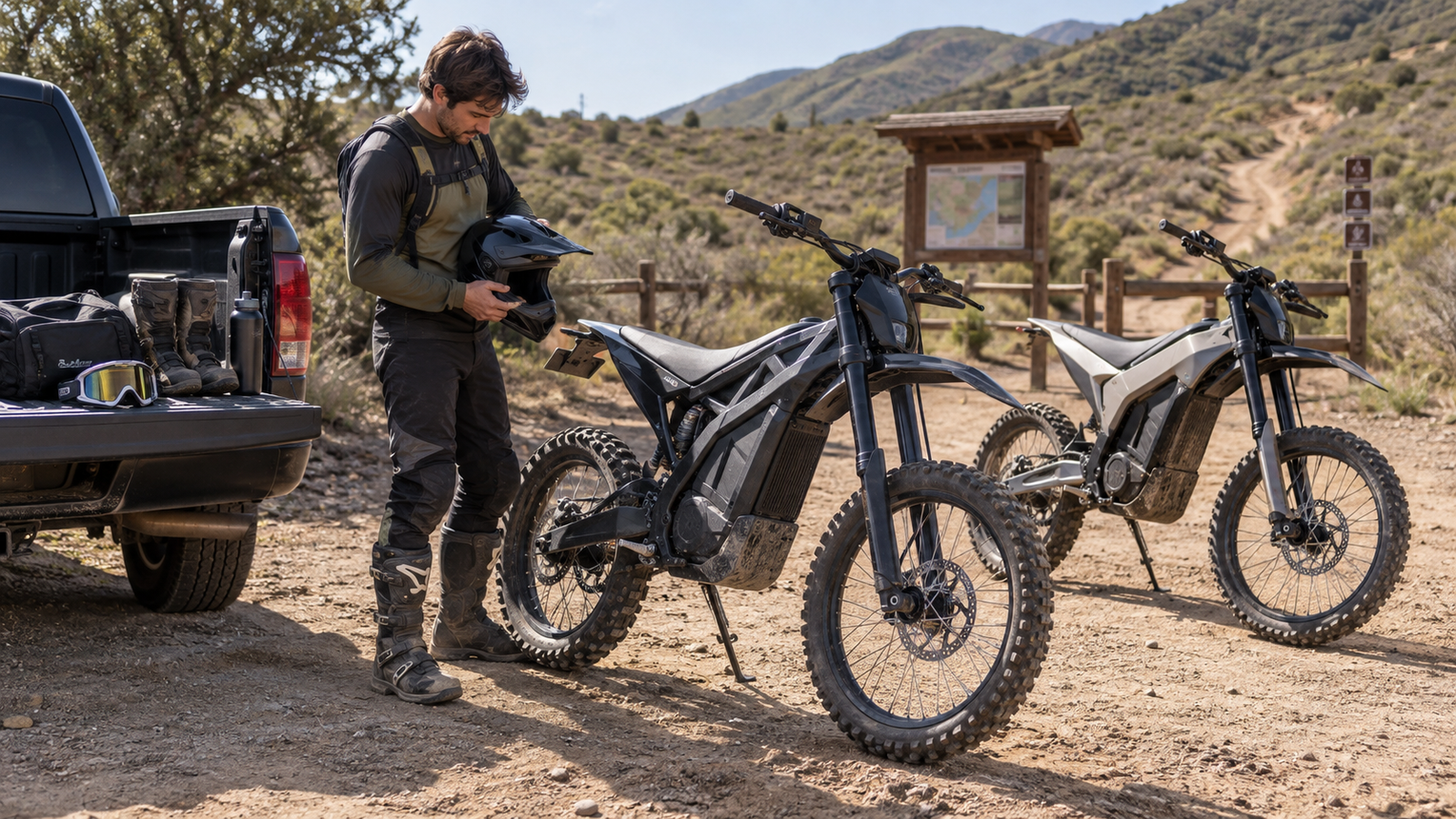
Quick answer: The best budget electric dirt bike is the one you can operate, maintain and legally ride after paying for the bike, protective equipment, delivery, wear parts and transport—not necessarily the listing with the largest peak-watt number. At the checked U.S. listing prices on October 13, 2026, the EKX TX1 starts at $1,499, while the EKX X21 Max starts at $1,949. Both can fit under a bike-only $2,000 ceiling, but neither is automatically a sub-$2,000 ready-to-ride purchase.
Commercial disclosure: We may earn a commission from qualifying purchases or other transactions made through links on this page.
Choose the budget you actually mean
There are three different questions hiding behind “best budget electric dirt bike.” A rider with $2,000 to spend on the vehicle itself has a different choice from someone with $2,000 for every upfront expense. And a buyer who expects weekly rocky climbs has a different cost exposure from someone riding gentle, permitted private-property trails twice a month. Do not compare those situations as if they were the same.
- Bike-only ceiling: what you can pay the seller today for the selected model and variant.
- Ride-ready ceiling: bike, appropriate off-road protective gear, freight/tax if applicable, necessary tools or setup, and a way to transport the vehicle to a legal riding area.
- First-season ceiling: ride-ready cost plus expected wear items, service, charging, storage, and a realistic reserve for unscheduled repair or returns.
For an electric dirt-style bike this powerful, there is also a fourth gate: permission to ride. A bargain becomes poor value when the owner has no legal place to use it. On U.S. Bureau of Land Management land, vehicles above the agency’s Class 1–3 e-bike limits are handled under off-highway-vehicle rules, not bicycle-trail access. Other land managers and states have their own rules (BLM e-bike FAQ).
Shortlist by the job, not the advertised maximum speed
The following are U.S. seller-listed figures checked October 13, 2026; prices, variants and shipping can change. Battery energy is calculated as nominal volts multiplied by amp-hours. It is not independently measured usable capacity or range. Sources: EKX TX1 listing; EKX X21 Max listing; Freego X2 Pro listing; Freego X1 listing; Freego X0 listing.
| Model | Observed advertised entry price | Listed power and nominal energy | When it makes sense | What can break the budget |
|---|---|---|---|---|
| EKX TX1 | $1,499 | 3,000 W rated / 7,000 W peak; 60 V × 30 Ah = 1,800 Wh | A lower initial outlay for permitted recreational off-road use | Ownership/service costs, ride weight, possible repair work and seller-policy uncertainty |
| EKX X21 Max (current 8,000 W offering) | From $1,949; other listed options can exceed $2,000 | 3,000 W rated / 8,000 W peak; 60 V × 30 Ah = 1,800 Wh | Buyer values this specific frame/feature set and has extra funds beyond sticker price | Very little headroom under $2,000, SKU/weight ambiguity, return exposure |
| Freego X0 Mini | $999 | 2,000 W nominal / 3,600 W peak rear hub; 60 V × 23 Ah = 1,380 Wh | Compact recreation when an adult specifically fits the mini chassis; 27.6-inch seat and 14-inch front/10-inch rear wheels | Not a full-size adult dirt-bike substitute, 220 lb load claim; seller stock text conflicts |
| Freego X1 | $1,699 | 1,500 W nominal / 3,000 W peak hub; 60 V × 25 Ah = 1,500 Wh | Light off-road/rough-surface comparison with 17-inch wheels and 31.9-inch seat | Distinct from 19-inch off-road setups; seller stock text conflicts; do not infer Class 1–3 access from city mode |
| Freego X2 Pro | From $2,199 | 3,000 W nominal / 6,000 W peak rear hub; 60 V × 30 Ah = 1,800 Wh in base configuration | A comparison benchmark when the buyer can increase the bike-only budget | Already over $2,000 before extras; 40 Ah option needs its own price; availability page is contradictory |
Why include two lower-price alternatives? Freego’s $999 X0 is explicitly a mini bike with 14-inch front/10-inch rear wheels and a 27.6-inch seat, and it lists a 220 lb load limit. It is not an adult full-size dirt bike at one-third the price. The $1,699 X1 has 17-inch wheels, a 31.9-inch seat, and a lower 1,500 W nominal / 3,000 W peak motor claim; Freego positions it for lighter off-road and uneven roads. Both product pages contain contradictory sold-out versus ready-to-ship messages. There is also a battery-label discrepancy on the X1 page: it describes a 60 V, 25 Ah pack as 1,620 Wh, while multiplying the stated voltage and capacity gives 1,500 Wh. The table reports that arithmetic, not a confirmed battery label or tested usable energy; ask Freego to verify the exact battery pack before comparing range. Their genuinely lower prices help a reader decide whether smaller/lower-performance equipment could meet the actual ride, but stock must be checked, and none is assumed to be a legally ordinary bicycle just because of a restricted operating mode (Freego X0 model and geometry; Freego X1 model and geometry).
Not a performance ranking: There is no controlled, same-rider test here of range, hill climbing, braking fade, durability or power delivery. The X21 Max’s larger advertised peak figure does not establish a measured improvement on the trail, and its nominal energy is no higher than the TX1’s. Freego is included as a budget-step-up benchmark, not represented as a cheaper alternative.
A $2,000 budget that looks adequate—until the rider actually checks out
Consider a transparent illustrative budget. The following $350 protection allowance, $150 service-and-wear reserve, and $100 transport/setup allowance are user-editable planning inputs, not dealer quotes or a claim that $350 buys all appropriate protective equipment. Appropriate helmets, boots, eye protection, gloves, body protection and fit can cost more; use actual quotes and safety requirements. Seller base prices are sourced above.
| Budget line | EKX TX1 example | EKX X21 Max example |
|---|---|---|
| Base listed bike price | $1,499 | $1,949 |
| Protective-equipment planning input | $350 | $350 |
| Wear/service reserve planning input | $150 | $150 |
| Transport/setup planning input | $100 | $100 |
| Illustrative total | $2,099 | $2,549 |
| Above $2,000 all-in ceiling | $99 | $549 |
These are arithmetic scenarios, not current retailer bundles. Subtract anything you already own and can safely reuse; add applicable tax, delivery, destination costs, protective gear quotes, tool purchases or professional setup. EKX currently advertises shipping and tax benefits on its U.S. product pages, but the TX1 page also says supply may ship directly from China when local warehouse stock is depleted. Confirm the shipping origin, all charges and actual ETA in writing rather than assuming the promotional line applies to every order (TX1 shipping section).
The purchase-price threshold is not the right upgrade threshold
The X21 Max costs $450 more than the TX1 at the checked entry prices. Both currently advertise 60 V 30 Ah battery packs, so the extra $450 is not buying more nominal stored energy. The X21 Max listing adds a different frame, fork and other equipment claims; that package may matter to a specific rider, but it does not eliminate the need to validate fit and actual suspension behavior. The TX1 weighs a claimed 56.2 kg (123 lb). EKX’s X21 Max descriptions themselves disagree on that model’s weight—48.2 kg in one specification and 53 kg in a TX1 comparison—so obtain an actual as-shipped weight for the exact selection (X21 Max technical listing; TX1 comparison chart).
What the cheap-bike calculation usually misses
1. The slowest wear item can stop the whole bike
Brake pads, tires, tubes, sprockets, chains, throttles, chargers and electronic modules are very different purchasing problems. A low-cost catalog listing for one part says nothing about whether it fits your model-year bike, remains in stock, or can be installed by a local technician. EKX has a visible spare-parts catalog, which is a starting point—not proof of model-specific local supply. Ask for actual replacement part numbers, delivery origin and current price for your selected variant.
2. A warranty claim can still consume cash and labor
The EKX warranty separates component coverage periods and includes a claims section requiring purchase proof and photo/video evidence. Its treatment of shipping and installation charges is not consistently worded: a general warranty passage implies some labor/shipping support, whereas the claim process says replacement-parts shipping may not be covered and installation requires authorization. The prudent budget assumption is not “every warranty repair is free.” Ask how a failed controller, brake or battery would be diagnosed, shipped and fitted in your ZIP code; save the written answer with the order.
3. Buyer-remorse returns may be an unusually expensive option
EKX’s FAQ currently describes non-defective return freight commonly around $150–$250, plus a 10%–15% restocking fee. Its separate return-and-refund page requires the product to remain unopened, unassembled and undamaged. These statements should not be blended into a single guaranteed “test ride and return” promise. If both FAQ fees were applied to a $1,499 TX1 return, the illustrative arithmetic would be $150–$225 restocking plus $150–$250 freight, or $300–$475, but eligibility, deductions, policy interpretation and actual return costs must be confirmed first. It may not be possible to return an assembled or ridden bike merely because you dislike it.
4. A motor label cannot predict sustained climbing
Rated and peak motor watts are not identical; a short-duration output claim is not a thermal endurance test. Neither 7,000 W nor 8,000 W on a listing gives the buyer a measured sustained torque curve, measured range on steep dirt, or a verified brake stopping distance. Hill gradient, rider mass, tire traction, battery state, controller limits and ambient heat all matter. For repeated long climbs, ask for an instrumented test at a matching rider weight and route; absent that evidence, treat “huge peak watts for the money” as an unproven performance advantage rather than a decision.
When the TX1 is a reasonable budget choice—and when it is not
Reasonable candidate: An adult owns suitable protective gear or has budgeted for it, has permission to ride on private land or designated motorized routes, can securely move/store a roughly 123 lb machine, accepts direct-to-consumer after-sales logistics, and wants to minimize initial price. The TX1’s published 7-speed pedaling setup is useful to understand but does not convert its claimed 3,000 W rated motor into a standard low-power e-bike (EKX TX1 specifications; BLM vehicle classification).
Poor fit: A new rider needs dealer assembly, local mechanical support and a generous trial/return window; a daily commuter needs bicycle-path access; or a trail rider expects documented repeated-jump durability from advertising alone. In those cases a locally serviceable, legally appropriate lower-power e-bike—or postponing the purchase while saving for the required machine and equipment—can be better value than a discounted high-power dirt-style bike.
How to compare a “cheap electric dirt bike” listing in six checks
- Exact configuration: Capture model name, dated SKU, battery volts and amp-hours, nominal and peak power separately, wheel/tire sizes and delivered weight.
- Use location: Identify the actual public-land managing agency or get the property owner’s permission. Do not infer lawful access from pedals, a low-speed display mode or seller marketing.
- Physical fit: Check seat height, reach, maximum payload, your ability to stabilize and recover the bike, and storage/lifting constraints.
- Running gear: Ask what brake system, pads, tire dimensions and replacement components ship on this configuration; request actual part numbers.
- Ownership response: Request in-writing labor, shipping, battery, controller and diagnostic obligations under warranty, plus regional service options.
- Real all-in quote: Put protective gear, delivery, tax, setup, transport, wear reserve and possible return charges below the seller’s number before you compare totals.
Battery charging is part of cost and safety, too: use the appropriate matched charger, follow the manufacturer’s instructions and do not charge unattended while asleep. The U.S. Consumer Product Safety Commission publishes general micromobility battery-safety guidance. Its guidance does not independently certify any bike in this article.
Budget verdict
Under a strict vehicle-only $2,000 limit, the EKX TX1 is the stronger price-first shortlist than the X21 Max at the checked entry prices because it leaves $501 rather than $51 before other costs. That is a financial conclusion, not a declaration that the TX1 is mechanically better, faster or safer. The X21 Max becomes rational only if you can afford the real ownership delta and specifically want its documented variant features. If your $2,000 limit includes riding gear and setup, neither may qualify.
After determining where you may ride and requesting a written total-cost/return quote, you can compare the current EKX lineup and entry prices. This affiliate link leads to the EKX homepage, not a validated model-specific product link.
Evidence and freshness: U.S.-focused merchant pages, federal-land rules and the linked EKX policies reviewed October 13, 2026. Listed prices and range/speed figures are seller claims, not independently measured results; customer experience and policy terms can change.