
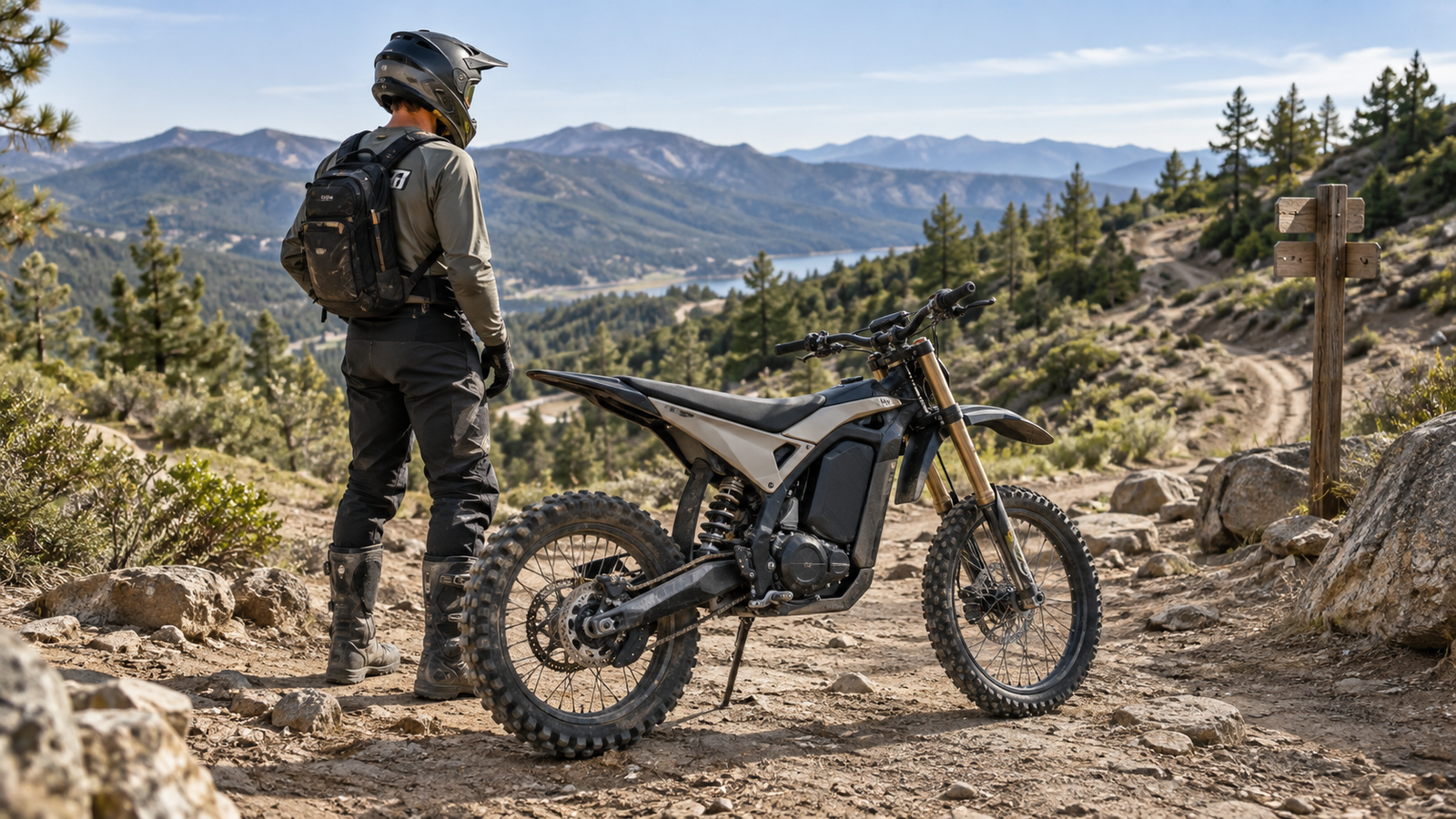
The best electric dirt bike for adults is the one that fits your rider size, terrain, riding permission and service capacity—not the model with the biggest advertised peak-watt number. For a price-sensitive rider with access to appropriate off-road ground, the EKX TX1 and X21 Max are candidates worth investigating. For buyers who prioritize a more explicitly documented higher-capacity e-moto platform, the E Ride Pro SS 3.0 belongs on the shortlist. A full-size, much heavier premium enduro such as the Stark VARG EX solves a different riding problem and should not be treated as a direct budget substitute.
Commercial disclosure: We may earn a commission from qualifying purchases or other transactions made through links on this page.
This U.S.-focused buying guide compares published manufacturer specifications and operating implications as of October 13, 2026. GearInsightWorks has not ridden or measured these motorcycles. Prices, performance and stock are seller claims; no independent cross-model test under controlled identical conditions was established.
Start with the adult rider’s intended terrain—not the horsepower
Four very different buyers can search for an ‘adult electric dirt bike’: a first-time rider on modest private trails, someone seeking a compact technical-trail machine, an experienced rider facing steep repeated climbs, and a full-size enduro rider who expects motorcycle-grade suspension travel. Calling one of those machines ‘best overall’ would hide the largest differences. Use this initial decision map to find the appropriate class.
| Rider’s actual need | Starting shortlist | Decisive fit check | Reason to reject it |
|---|---|---|---|
| Lower-cost recreational off-road riding | EKX TX1 | Reach, braking support, local servicing and permitted terrain | Unclear warranty/replacement-parts support or unsuitable cockpit |
| Budget-conscious buyer considering greater advertised output | EKX X21 Max | Exact revision, suspension setup, bike weight and electrical parts compatibility | Buyer needs road-legal commute or assumes merchant speeds are validated |
| Higher-capacity compact e-moto with published fit dimensions | E Ride Pro SS 3.0 | 830 mm seat height, 265 lb published load limit and service logistics | Delivered cost, seat height or load capacity does not fit |
| Experienced rider seeking a full-size enduro chassis | Stark VARG EX | 99 cm extended seat, 264 lb bike weight, full-size suspension and authorized support | Insufficient skill, transport/lifting ability, storage or budget |
Sources: EKX TX1, EKX X21 Max, E Ride Pro SS 3.0 and Stark VARG EX manufacturer product pages. These do not prove comparative ride quality or reliability.
Four adult electric dirt bike candidates, with their important differences
| Model | Battery / nominal energy | Power as published | Mass / fit information as published | Advertised price context |
|---|---|---|---|---|
| EKX TX1 | 60 V × 30 Ah = 1.8 kWh | 3 kW rated / 7 kW peak | Height recommendation 158–195 cm; max load 150 kg; confirm net weight with seller because EKX tables differ | From about $1,499 |
| EKX X21 Max | 60 V × 30 Ah = 1.8 kWh | 3 kW rated / 8 kW peak | About 106 lb claimed; height 165–195 cm; max load 150 kg; measured seat height not established | From about $1,949 |
| E Ride Pro SS 3.0 | 72 V × 50 Ah = 3.6 kWh | 6 kW rated / 15.8 kW peak | 167 lb; 32.7 in / 830 mm seat; 265 lb published maximum load | $4,699 plus $300 U.S. shipping on product page |
| Stark VARG EX | 7.2 kWh battery stated | 60/80 hp configuration described by manufacturer | 264 lb; 99 cm seat fully extended and 96.6 cm with static sag; 300 mm front/303 mm rear travel | Premium full-size class; final configuration price requires checkout |
Product-level evidence: TX1 listing, X21 Max listing, Pro SS 3.0 listing, VARG EX technical details. Battery Wh figures computed from published nominal V × Ah and cannot be treated as tested usable energy. Stark’s battery figure is its own published capacity. Units and measuring conventions for vehicle weight and payload may vary.
EKX TX1: shortlist if initial price is the limiting factor
EKX lists a 60 V / 30 Ah system, 3,000 W rated motor and up to 7,000 W peak output for the TX1. Its advertised price begins well below the E Ride Pro and Stark options, which may free budget for necessary protection and mechanical inspection. That is the credible attraction: the advertised configuration and price, not a verified independent assessment of durability or the bike’s ability to sustain full output.
Check its actual loaded rider geometry, rear shock and fork setup, brake hardware and parts supply. The seller’s own pages have shown differing TX1 net weights, which makes it prudent to ask for the packed weight and ride-ready curb weight on the exact version before buying a carrier, ramp or hitch rack. Avoid this model if you cannot find a shop prepared to inspect and service its high-power electrical and braking system. Source: EKX TX1 official product page.
EKX X21 Max: shortlist if you accept version and ownership due diligence
The Max’s current 60 V / 30 Ah and 8,000 W peak advertisement positions it above the TX1 on headline power, but both list the same nominal 1.8 kWh battery energy. That does not establish which lasts longer on a steep trail. Its inverted fork and hydraulic brake descriptions are purchase clues, not independent proof of fade resistance, suspension control or reliability. Ask for service parts, exact revision and a written warranty answer before accepting the modest price step up over TX1. Source: EKX X21 Max listing.
EKX’s older original X21 is a different 48 V platform; its 2,000 W peak figure must not be attributed to the X21 Max. If a third-party storefront mixes X21-family photos or quotes, verify labels, battery type and the model-year invoice.
E Ride Pro SS 3.0: a stronger battery-and-fit documentation case at a higher price
E Ride Pro publishes a 72 V / 50 Ah, 3,600 Wh battery, 6 kW rated / 15.8 kW peak motor, 19-inch front and 18-inch rear tire sizes, 32.7-inch seat height, 167 lb bike weight and 265 lb load limit. It also provides condition-qualified range marketing, which should not be compared directly against EKX’s unstandardized mile claims. At the listed $4,699 plus $300 shipping, the cost increase over EKX is substantial. For an adult who fits the published load/seat limits, the more extensive fit information and larger nominal energy budget are useful reasons to investigate further—not evidence that it rides better without a test. Source: E Ride Pro SS 3.0 manufacturer’s specifications.
Stark VARG EX: a different full-size enduro decision
Stark positions the VARG EX as a full-size enduro with 300 mm front and 303 mm rear suspension travel, 21-inch front and 18-inch rear tire sizing, an approximately 99 cm fully extended seat and a 264 lb vehicle weight. Those dimensions matter more to a tall, experienced rider tackling enduro terrain than a simple motor-peak comparison. They are also meaningful disadvantages for someone who struggles to mount, maneuver, transport or recover a heavy bike. The current U.S. manufacturer’s page advertises dealer support and configurable performance; review the exact package, regional registration documents and final delivery cost for your location. Source: Stark VARG EX technical and support page.
How to find the right adult fit before placing an order
Published rider-height recommendations are only a first screen. The serious fit check has five parts:
- Inseam and saddle height: Can the rider mount and balance the bike confidently with actual riding boots? A seller’s broad height range is not a measured seat height. Compare unladen height and loaded sag.
- Standing cockpit and reach: Does bar position permit controlled standing posture without awkward wrist or back angles? Request reach and handlebar measurements if a local demonstration is impossible.
- Payload and protective equipment: Does the bike’s published maximum load include the fully equipped rider plus carried gear? Ask how the manufacturer defines that number; don’t assume two sellers use identical conventions.
- Suspension adjustment: Can the spring and damping settings support your weight on the intended ground? A ‘full suspension’ badge does not specify travel, valving, tuning range or stability.
- Bike mass versus recovery: Can you push, load and stand the machine up after a slow fall without unsafe assistance? This matters on isolated trails and at home.
Why peak watts, range and 72 V alone cannot select the winner
Motor peak output describes a temporary electrical or mechanical output claim whose test conditions may differ between manufacturers. A 72 V system is not automatically faster, safer, or more reliable than a 60 V system. Nominal battery energy gives a capacity clue: 60 × 30 = 1,800 Wh for each listed EKX bike, compared with 72 × 50 = 3,600 Wh for the E Ride Pro. Double nominal Wh does not guarantee double miles because terrain, tires, throttle use, efficiency, accessible battery capacity, output restrictions and rider mass are different.
A more defensible ride-time conversation asks: What was the test route? How much climbing, at what sustained power? What rider mass and tire pressures? What speed, weather and battery end point? If a vendor cannot supply comparable test data, treat the range figures as incomparable marketing maxima and plan conservatively. On long remote rides, safe return planning and a known charging solution are more valuable than peak-mile advertising.
Brakes, tires, suspension and service are the actual purchase filter
| Terrain or ownership need | What to demand | Reason a headline specification misleads |
|---|---|---|
| Long descents | Correct brake components, pad availability, service schedule and suitable riding technique | Hydraulic brakes do not themselves quantify heat/fade performance |
| Rocks, ruts and repeated impacts | Wheel and tire fit, actual suspension travel, loaded sag and damping support | Peak watts say nothing about chassis composure |
| Repeated climbs | Rated/sustained capability and temperature behavior under comparable conditions | Short-duration peak power can exceed sustainable output |
| Small garage and solo loading | Ride-ready weight, dimensions, appropriate rated loading system and handling | Published bike weights may use different conventions |
| Keeping a bike for years | Battery/charger approval, brake/axle spares, repair labor, warranty freight and dealer availability | A great introductory price does not guarantee low ownership cost |
The legality and charging checks that can veto any shortlist
Before choosing an off-road electric machine, identify an actual permitted riding venue. Pedals or a marketing ‘e-bike’ label do not grant bike-lane access, roadway registration or nonmotorized-trail rights. The U.S. Bureau of Land Management’s e-bike FAQ sets out electric-assist class rules and land-access restrictions, with high-power vehicles subject to different motorized/OHV requirements. State laws and other land-management agencies may differ. Confirm the precise route’s permission and your vehicle’s classification independently, and do not purchase on an assumption of city-road legality.
High-capacity lithium packs also make charging equipment and safe storage part of the purchase. The U.S. Consumer Product Safety Commission recommends device-approved batteries and chargers, monitoring charging, never charging while asleep, and avoiding modified or unapproved battery packs. Do not improvise a charger or infer battery compatibility from connector shape.
Compare the full cost of a season, not just the sticker
Use a quote-based formula rather than unverified cost estimates: season-one ownership cost = delivered bike and tax + protective equipment + inspection/setup + expected tires/brake consumables + transportation/storage + any uncovered repairs. Request a local shop’s labor quote and the seller’s written battery, charger and spare-parts availability. For EKX, pay special attention to its warranty’s differing component terms and the conflicting FAQ return summary versus full return page. For other brands, obtain their own written service and freight terms rather than assuming premium pricing guarantees support.
Pre-purchase worksheet: six decisions that cannot be skipped
- Write down three actual riding routes, land managers and the permitted vehicle type at each.
- Record rider height, inseam, equipped weight and ability to handle the bike’s ride-ready mass.
- Rank terrain: flat dirt, technical trail, repeated climb, steep descent or full-size enduro.
- Confirm who will service brakes, suspension, drivetrain, high-voltage electronics and approved battery/charger replacements.
- Ask for final landed price, specific model/revision, return conditions after assembly, and who pays labor/freight for warranty work.
- Plan riding protection, transportation and safe attended charging before committing to the bike.
Verdict by use case: Explore the EKX TX1 for an entry-price off-road shortlist and X21 Max for a higher advertised-output configuration if you can resolve support and variant questions. Move to E Ride Pro SS 3.0 when its documented battery/fit envelope suits the rider and the higher landed price is justified. Look at full-size platforms such as Stark VARG EX only when the rider, terrain, support and transport requirements truly warrant them. See current EKX models and options if the budget-focused alternatives suit you; this is a homepage link, not a verified model-specific checkout. No recommendation overrides local riding restrictions, fit or unresolved safety questions.