
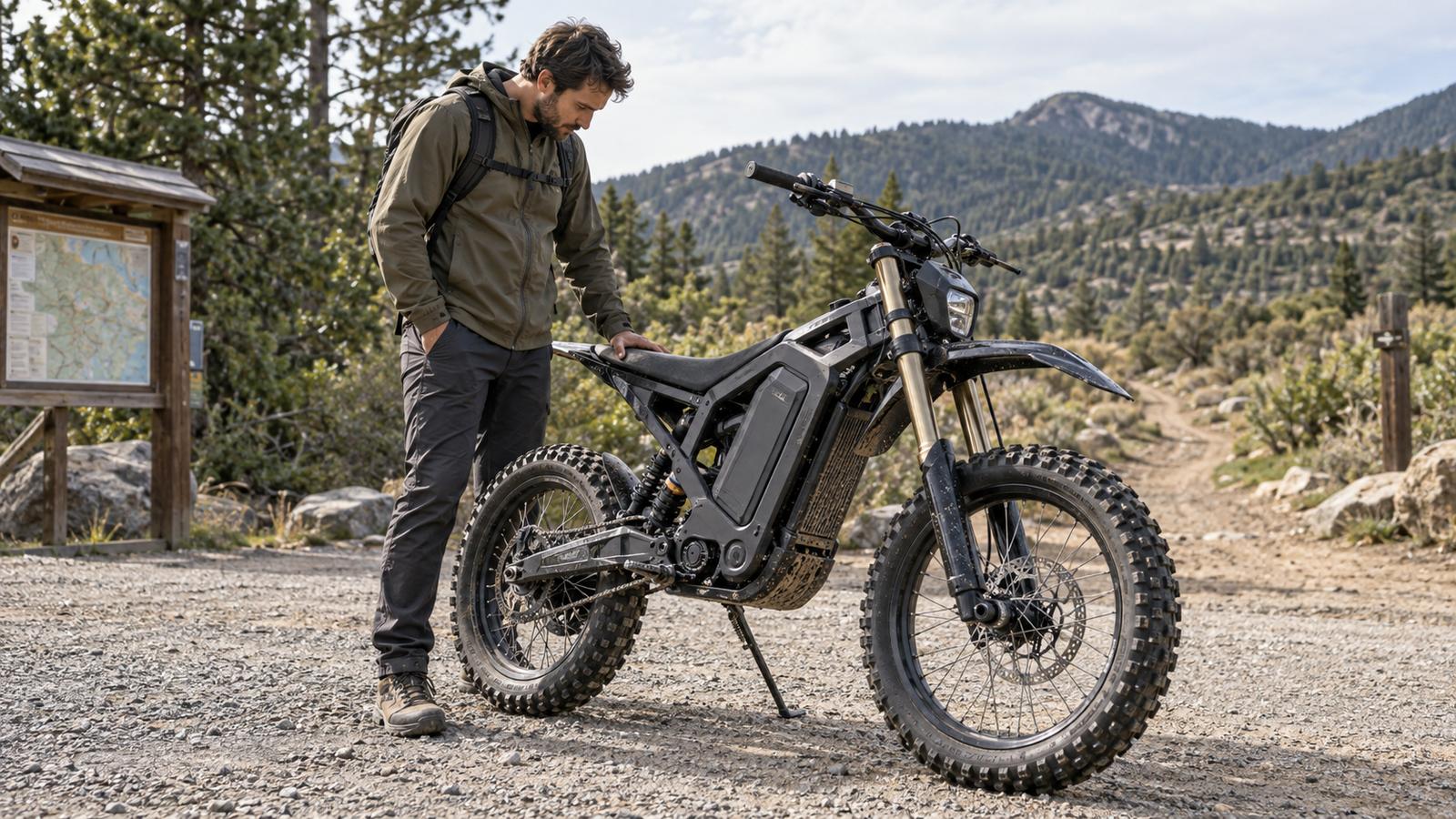
EKX bike buying verdict: EKX deserves consideration if your priority is a high-output electric off-road bike at a relatively low advertised purchase price, you have an appropriate place to ride it, and you are comfortable verifying support and ownership terms before paying. It is a weaker choice if you need a conventional low-speed commuter e-bike, assured local dealer servicing, or a risk-free test-ride return. This assessment is based on current documentation and public owner reports—not a GearInsightWorks ride test.
Commercial disclosure: We may earn a commission from qualifying purchases or other transactions made through links on this page.
Research checked: October 13, 2026. U.S. product pages and policies were the starting point; prices, options, inventory, legal access, and after-sales terms can change.
What EKX sells—and what an EKX bike actually is
EKX markets several vehicles under the overlapping labels e-bike, electric dirt bike, and off-road bike. These names do not by themselves identify the legal vehicle class or the intended riding environment. EKX’s current electric-bike collection shows models at different power, price, and drivetrain levels. For buyers, the useful distinction is not simply ‘which EKX is fastest?’ but whether the vehicle’s construction, usable battery energy, service requirements, and permitted riding location fit the planned use.
| Model family | Seller’s published power architecture | Price signal at check | Best reason to investigate | Main buyer caveat |
|---|---|---|---|---|
| Original X21 | 48 V, 35 Ah; 1,000 W rated / 2,000 W peak | About $1,349 on its listing; shown sold out | Older fat-tire/pedal-style platform | Do not confuse its parts or claims with X21 Max |
| TX1 | 60 V, 30 Ah; 3,000 W rated / 7,000 W peak | From roughly $1,499 | Lower-cost entry to the current dirt-style lineup | Motor figures do not establish usable off-road performance |
| X21 Max | 60 V, 30 Ah; 3,000 W rated / 8,000 W peak | From roughly $1,949 | Higher-output option without moving into premium e-moto pricing | Product imagery and historic versions can reference different figures |
| GTS X22 | 72 V platform; hub-drive family | About $2,499–$2,649 | Buyer considering a step up in voltage/output class | Verify exact offered revision, suspension and parts |
| M1 | 72 V family; mid-drive rather than hub-drive | About $4,799–$4,999 | Buyer specifically evaluating a mid-drive layout | Different ownership and service assumptions from hub models |
Primary product evidence: EKX original X21 listing, TX1 listing, X21 Max listing and all-products catalog. These are seller specifications and captured listing prices, not independently tested output, verified stock, or guaranteed checkout totals. The lineup and available configurations may change.
The five checks that matter more than advertised peak watts
1. Ask what the numbers describe
Power pages mix rated output, peak output, torque and top-speed marketing. Rated and peak motor figures measure different conditions; neither says how long full output is available on a hot climb, under a heavy rider, or with a depleted battery. A claimed 55 or 60 mph top speed is not independent proof of speed, safe handling, braking capacity or road legality. Ask for the exact motor and controller revision, continuous rating, supported rider load and operating conditions. For high-speed off-road use, brake service and suspension setup should be part of the decision, not afterthoughts.
2. Translate battery labels into energy—then stop short of promising range
The TX1 and X21 Max currently advertise 60 V × 30 Ah, equal to 1,800 Wh of nominal battery energy by arithmetic. The original X21 lists 48 V × 35 Ah, equal to 1,680 Wh. This calculation does not verify usable capacity, battery-cell quality, battery management behavior or real riding distance. Riding range depends on terrain, speed, tire choice, acceleration, rider weight and temperature. If you need a minimum ride duration, request a test under conditions resembling yours rather than relying on a headline mileage claim. Sources: X21 Max and X21.
3. Check the chassis, fit and real support network
Seller height ranges and maximum loads are useful screening numbers, but they do not give you measured seat height, loaded suspension sag, reach, or whether the bike is comfortable in standing off-road posture. Ask for actual measurements and a local service shop willing to inspect an unfamiliar high-power electric platform. EKX publishes downloadable model-family manuals and replacement-part listings; neither proves parts are interchangeable or in stock when you need them.
4. Treat warranty details as model-specific—not a blanket promise
EKX’s published U.S./Canada limited warranty says its newer policy applies to qualifying purchases from March 15, 2026 and describes one year for frames and certain components, while batteries are limited to one year or 300 charge cycles, whichever occurs first. The same page has a more detailed schedule giving some brakes/accessories three months and certain drivetrain and suspension components six months. It also has inconsistent language about labor and shipping being paid by EKX versus excluded without after-sales authorization. Therefore, do not interpret ‘one-year warranty’ as ‘all repairs and freight are free.’ Request an email confirming coverage, return freight, shipping of parts and authorized shop labor for your exact SKU and destination.
5. Resolve the return-policy contradiction before unboxing
EKX’s FAQ advertises a 30-day satisfaction period that can include a like-new bike with fewer than 10 miles and warns of approximately $150–$250 return freight plus a 10%–15% restocking charge for non-defective returns. A separate Return & Refund policy, however, requires an unopened and unassembled product and describes deductions for original shipping and bank transaction charges. Those are materially different expectations for a buyer who wants a trial ride. The responsible rule is: do not assume riding it is return-safe until EKX confirms, in writing, which policy controls your order and what refund deductions would apply.
Can the seller and owner experience be trusted?
There is a difference between establishing that a merchant has reachable pages and proving reliable resolution of every future warranty claim. EKX’s About page identifies the brand and publishes a company/manufacturer attribution in its footer; the site also exposes a support contact route. These are useful starting points, but they are not an independent audit of manufacturing, legal identity, stock location or after-sales capacity.
Public experience reports are mixed. Trustpilot’s limited review set includes positive service accounts and serious negative delivery/service complaints. In X21 Max owner discussions, some people like the price-to-spec offering while others describe component and communication problems; at least one account involved a third-party marketplace rather than a direct EKX order. A separate owner thread discusses isolated safety-related hardware or connector concerns. These posts are unverified experiences, not a defect-rate study. Their actionable value is identifying questions to put to the seller: axle/fastener inspection support, parts supply, battery diagnostics and written escalation procedures.
Is an EKX bike legal on roads or public trails?
Do not infer road or cycle-path permission from having pedals, from an ‘e-bike’ label or from a listing that uses ‘street legal.’ EKX’s displayed rated motors are above the 750 W limit associated with the familiar U.S. low-speed e-bike framework. Classification and access differ by state, location and specific route. On U.S. Bureau of Land Management lands, its e-bike guidance explains the power/class distinctions and the need to check the applicable land-management decision or motorized/OHV route restrictions. Private-property permission and official designated off-road access are entirely different from general highway permission. Obtain location-specific guidance before purchase, especially if the only riding opportunity is a bike path or commuter street.
Practical ownership budget: price is only the first line
| Cost line | What to verify | Why it changes the decision |
|---|---|---|
| Bike and shipping | Exact SKU, taxes, destination surcharge, delivery option and origin | Catalog prices are not necessarily landed prices |
| Riding protection | Appropriate helmet and off-road protective gear | Higher-performance riding imposes different injury exposure |
| Inspection and service | Qualified pre-ride inspection, brake and suspension servicing | Online supply does not guarantee a local mechanic |
| Wear and replacement parts | Brake pads, tires, controls, correct battery and charger | Parts are version-specific and may require shipping |
| Return/warranty exposure | Written repacking, freight, restocking and authorized labor terms | An unsuitable purchase can be costly to unwind |
For battery charging, follow device-specific instructions and use the charger supplied or expressly approved for the exact system. The U.S. Consumer Product Safety Commission advises attending charging, avoiding charging while asleep and using only compatible replacement packs and chargers. Do not treat a physically fitting plug as proof of electrical compatibility.
Who should shortlist EKX—and who should not?
- Reasonable shortlist: An adult with permission to ride suitable off-road terrain, mechanical support arranged, and a budget that favors EKX’s current lower-priced platforms over premium e-motos; willing to get model and policy assurances in writing.
- Investigate alternatives first: A rider who prioritizes a nearby authorized dealer, measured independent performance, a comprehensive known suspension setup or straightforward return terms. Compare total support value, not just catalog watts.
- Avoid this category for now: Someone shopping for a compliant cycle-lane commuter, depending on public nonmotorized access, or unable to safely store and charge a large lithium-battery vehicle.
The email checklist before paying
- Confirm the exact model name, model-year/revision, motor rated versus peak output, battery label and current stock—request images of the actual specification labels where possible.
- Ask for measured seat height, intended rider weight range, payload accounting, wheel sizes and compatible suspension settings.
- Request the specific battery pack, charger output, BMS/connector compatibility and replacements available in your country.
- Ask which written warranty schedule applies, whether shipping and labor are covered, and whether claims require a dealer.
- Ask if assembling and test-riding affect returns; request a scenario-specific refund calculation in writing.
- Confirm the shipping origin, carrier handoff, damage-documentation deadline and your local riding access independently.
Bottom line: EKX can be a legitimate shortlist candidate on published price and configuration, but it is not a verified bargain until the product revision, local use case and ownership risks are clear. If EKX answers those questions satisfactorily, review EKX’s current lineup and purchase options. If the answers remain vague, defer the order or prefer a locally supported alternative.