
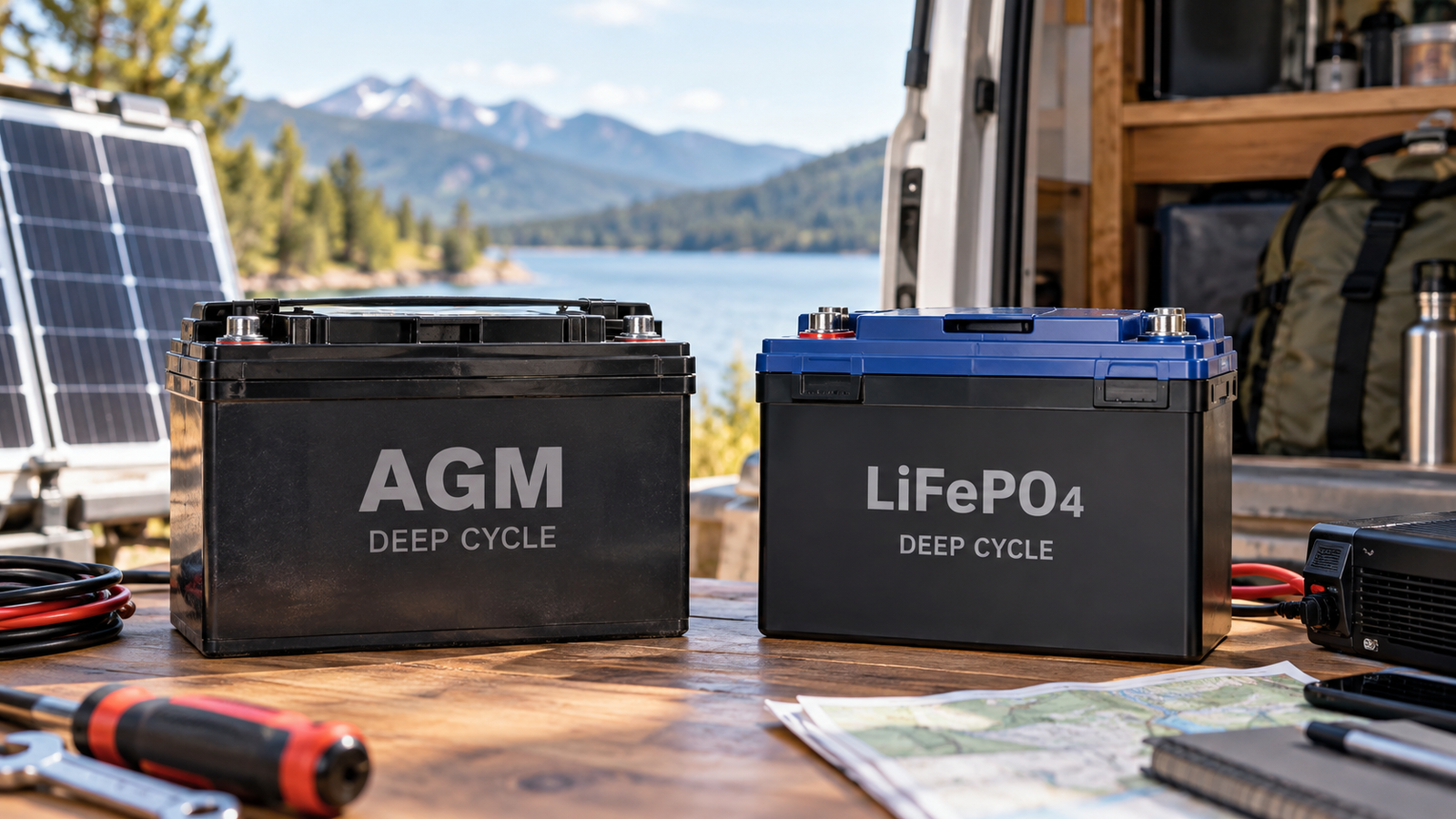
Short answer: In the LiFePO4 vs AGM decision, lithium iron phosphate often offers more working energy for a given nominal amp-hour rating and much lower carrying weight. But it is not an automatic financial upgrade. AGM can be the rational choice if you already have a serviceable lead-acid charging system, need a documented specialist AGM duty cycle, use the battery infrequently, or face an installation where lithium charging and protection requirements would be expensive to satisfy.
This U.S.-market comparison uses specific, named products to explain chemistry trade-offs, not the assumption that every AGM or LiFePO4 model performs alike: a Renogy Deep Cycle 12V 100Ah AGM, a WattCycle 12V 100Ah Mini Bluetooth LiFePO4, and the specialist Trojan T105-AES 6V AGM as an important counterexample. Specifications were checked October 13, 2026. These are published manufacturer claims; GearInsightWorks did not capacity-test or cycle-test these batteries.
Start with the decision that really matters: operating pattern
| What your system needs | LiFePO4 direction | AGM direction |
|---|---|---|
| Frequent deep discharge; limited mounting space or weight | Strong candidate where charge profile, BMS current and temperature limits are met | Evaluate if premium deep-cycle models/charging economics still work |
| Occasional low-demand seasonal use; good existing AGM charger | Only if the added energy/weight benefit outweighs conversion and monitoring costs | Retaining a healthy AGM setup may be cheaper overall |
| High-current engine starting or specialty equipment | Use only a battery explicitly rated for that cranking/start use; ordinary drop-in deep-cycle LiFePO4 may not qualify | Choose a correctly rated starting/dual-purpose AGM where supported |
| Charging and storage in cold conditions | Verify pack’s charging cutoff, sensor placement and heated-model behavior | Check exact AGM’s charging temperature and charging-voltage adjustment; AGM is not universally below-freezing charge-approved |
| Industrial/deep-cycling where a premium AGM is already specified | Possible only if OEM approvals, charging, controls and cost support conversion | Specialty AGM may be designed for far deeper cycles than ordinary 50% planning rules imply |
The central mistake: Buying by “100Ah” alone ignores chemistry, discharge rate, usable state-of-charge range and downstream equipment. Amp-hours are meaningful only with a voltage and test context. The next comparison is a product-specific example, not a scientific proof that one chemistry lasts an exact multiple of the other.
Two 100Ah batteries: what the manufacturer specifications actually say
| Specification | Renogy Deep Cycle AGM 12V 100Ah | WattCycle Mini Bluetooth 12V 100Ah LiFePO4 | How to use it |
|---|---|---|---|
| Battery rated voltage and capacity | 12V × 100Ah; capacity stated at 10-hour rate down to 10.5V | 12.8V × 100Ah; 1,280Wh nominal | Compare watt-hours and discharge assumptions, not Ah without voltage |
| Nominal energy arithmetic | 1,200Wh | 1,280Wh | Rated energy is not equal to AC-delivered useful energy |
| Weight | 63.9lb (29kg) | 20.8lb (~9.4kg) | About 43.1lb less for this particular lithium model |
| Cycle-life claim | 500 cycles at 50% depth of discharge | 5,000+ cycles at 100% depth of discharge, as advertised | Different products/test conditions; not a validated comparative lifespan |
| Published charging parameters | Cycle 14.4–14.8V; float 13.5–13.8V; maximum continuous charge 30A | CC/CV around 14.6 ± 0.2V; 20A recommended; higher stated maximum needs exact-model confirmation | Existing charger settings must be checked, not presumed equivalent |
| Charging temperature on cited models | 0–50°C (32–122°F) | 0–50°C; BMS low-temperature charge cutoff and recovery specified | Neither named product automatically authorizes charging below freezing |
| Monitoring and high-current behavior | No built-in Bluetooth on cited Renogy SKU; listed short-duration discharge is different from normal continuous capacity | Bluetooth; 100A continuous-discharge BMS published | Specific load demands and continuous vs short peak duty must be separated |
Source: Renogy’s product technical specifications and charging FAQ and WattCycle’s Mini Bluetooth technical specifications. The Renogy capacity rating is explicitly tied to a 10-hour discharge rate; the WattCycle product statement does not establish directly equivalent test conditions. Do not present the resulting nameplate figures as tested capacity at a particular inverter load or winter temperature.
Usable watt-hours: a transparent planning illustration
The widely quoted advice to use no more than about half an ordinary AGM battery’s nominal energy is a conservative planning convention for many applications, not a law of AGM chemistry; see, for example, Renogy’s battery-bank planning discussion. Renogy’s guidance for the cited AGM says discharging past 50% can shorten service life, while Trojan’s premium AES AGM has a different deep-cycle design and duty claim. A LiFePO4 buyer may use a different working window, but the proper reserve is defined by pack/BMS settings and desired longevity.
Illustrative assumptions only: take an ordinary AGM 12V100Ah’s 1,200Wh nameplate and voluntarily reserve 50%; take the cited LiFePO4’s 1,280Wh nameplate and voluntarily reserve 20%. Ignore discharge-rate variation, conversion losses, battery aging, voltage cutoffs and cold effects.
| Example | Working-depth assumption | Simple energy budget |
|---|---|---|
| Renogy AGM 12V100Ah | 50% of nominal | 1,200Wh × 0.50 = 600Wh |
| WattCycle LiFePO4 12.8V100Ah | 80% of nominal | 1,280Wh × 0.80 = 1,024Wh |
| Illustrative comparison | Different reserved working windows | 1,024Wh ÷ 600Wh ≈ 1.71× the planned usable energy |
That ratio follows from the illustration’s assumptions, not a promise that one WattCycle equals 1.71 Renogy batteries in every task. A high AC load can reduce accessible energy through inverter and discharge-rate effects; cold can make a BMS refuse charging; an AGM designed for a different depth of discharge changes the comparison. To plan a real RV or boat bank, measure daily loads and check usable energy at the specific discharge rate and battery temperature.
Cycle life claims are not a head-to-head durability test
Renogy lists 500 cycles at 50% DoD on its conventional AGM SKU. WattCycle advertises 5,000+ cycles at 100% DoD on the selected Mini Bluetooth product. Manufacturers may use different definitions of end-of-life capacity, discharge currents, temperature, calendar age and test methods. Without matched independent testing, calculating “WattCycle lasts ten times longer” would overstate the evidence. Even a long cycle claim does not guarantee the battery will work for that many years in a hot enclosure or a poorly configured electrical system.
More importantly, AGM is not one uniform cycle-life category. Trojan’s T105-AES is a 6V premium deep-cycle AGM marketed for equipment such as industrial cleaners, golf carts and marine use. Trojan itself describes testing to 1,200 cycles at 100% DoD versus 400 for a general AGM comparator. This is useful counterevidence to an absolute “never discharge AGM deeper than 50%” claim. It is still Trojan’s manufacturer claim, not our third-party measurement, and its 6V bank design is not a direct 12V replacement for either 100Ah sample. Such a system may need two 6V units in series where the OEM approves it.
The better lifespan question is: How many cycles per year does my actual duty require, at what DoD, temperature and charge profile—and what capacity retention is guaranteed under the written warranty? A boat used 15 weekends per year and an off-grid tool system cycled every working day do not have the same replacement economics even if both buy 100Ah batteries.
Three integration mistakes that can erase a battery saving
1. Keeping a charger simply because the label says “12V”
The cited Renogy AGM specifies distinct cycle-use (14.4–14.8V) and float (13.5–13.8V) parameters. WattCycle specifies lithium CC/CV charging around 14.6V ±0.2V for its selected model. The numbers overlap, but the charging algorithm may not: lead-acid desulfation/recondition/equalization stages or temperature-compensated modes can be unsuitable for LiFePO4. The Victron Blue Smart IP22 manual explicitly distinguishes its Li-ion program from lead-acid charging and recondition modes. The correct outcome is to validate the charger and battery manuals together, not declare every nominally matching charger compatible.
2. Confusing momentary start current with continuous inverter draw
Renogy publishes a very brief high-current discharge figure for its AGM, while WattCycle lists a 100A continuous discharge BMS for the named LiFePO4 model. These figures represent different operating intervals and are not a fair “which has more power?” test. An engine starter may require a product explicitly rated for cranking/CCA; a refrigerator and inverter impose different steady and transient demands. Do not replace a starting battery with a house/deep-cycle LiFePO4 merely because it has equal Ah or a lighter case. Confirm the equipment manufacturer’s permitted chemistry and the exact battery’s peak and continuous duty ratings.
3. Treating subfreezing discharge as subfreezing charging approval
The Renogy AGM product publishes 0–50°C as its own charging-temperature range while allowing colder discharging. The WattCycle Mini Bluetooth likewise lists a 0°C charge cutoff with recovery at higher temperature in its BMS specifications. Therefore “AGM charges safely below freezing, unlike lithium” is not proven by these two products. Other AGM constructions and charging algorithms may behave differently; use the actual battery-maker limits. A heated LiFePO4 can add energy consumption, warm-up time and additional failure modes, and the specifics vary by model.
Lifetime cost: a decision tool, not a fabricated price prediction
Comparing prices at checkout misses the cost of the charger, wiring, monitoring, protective hardware, installation and possible replacement. A fair financial model can be built with the variables below. Use real quotes and the actual warranty terms, not headline “up to X times more cycles” marketing.
| Illustrative six-year scenario | AGM path | LiFePO4 path |
|---|---|---|
| Battery purchase quote (assumed) | $250 | $400 |
| Charger/installation upgrades (assumed) | $0 using approved existing AGM equipment | $180 for needed upgrades |
| If each pack needs no replacement over six years | $250 | $580 |
| If AGM needs one $250 replacement; LiFePO4 needs none | $500 | $580 |
| If AGM needs two replacements while LiFePO4 needs none | $750 | $580 |
In this made-up scenario, the lithium path only becomes cheaper in the last row; a different actual quote or a defective lithium system reverses the result. The example intentionally excludes labor for replacements, time value of money, charging energy, resale/scrap value and disposal fees. Do not interpret its $250, $400 or $180 inputs as manufacturer prices. Your real decision should compare total installed cost per service delivered, with a conservative view of product life and working energy.
For an occasional-use owner who will not cycle enough to consume either chemistry’s life, additional cycle capability may have little cash value. Conversely, a weight-sensitive equipment platform or a frequently cycled field system can justify a higher upfront cost even before a payback calculation. That is an operational benefit, not a promise of guaranteed savings.
What the premium AGM alternative changes
A fair chemistry article needs to include not just a low-cost AGM and a lithium replacement but also a buyer who should not switch. The Trojan AES AGM family targets demanding deep-cycle uses and says it tolerates repeated partial-state-of-charge operation. For an approved industrial or marine bank already engineered around that chemistry, preserving it may eliminate conversion risk. That does not mean Trojan’s 6V module is drop-in equivalent to the 12V 100Ah Renogy or WattCycle examples; the pack count, charger and system voltage must be engineered separately.
A LiFePO4 option becomes more attractive when the same application needs lower battery-bank weight, frequent recharge cycles, higher usable working energy and BMS monitoring, and the electrical platform can meet its specific requirements. Choose the battery by a working load profile, not by a generalized chemistry slogan. If the charger and wiring are already close to their design limits, converting may require a professional electrical redesign rather than a cheap battery swap.
Who should choose each approach?
- Choose a documented LiFePO4 system when frequent cycling and weight/space constraints matter, current/temperature/charging specifications are verified, and the new system’s total quote is acceptable. A documented 12V house-bank application may fit; a high-current cranking use requires a specially rated model.
- Keep or replace AGM when the present charger is approved and in good order, expected cycling is limited, conversion parts and labor would outweigh the energy benefit, or the equipment supplier specifies a particular AGM deep-cycle design.
- Choose neither until you have more evidence when you cannot identify the existing converter/charger mode, the battery will be charged below its permitted temperature, the battery’s continuous/surge current falls short, or an equipment warranty/authority has not approved chemistry substitution.
What would reverse the choice? A newly available battery-specific test report, an updated charger/manual, a current installation quote, an equipment manufacturer approval (or prohibition), or a measured duty-cycle log. Each can change the financial and technical answer. Vendor cycle-life numbers on their own cannot settle the decision.
Commercial disclosure: We may earn a commission from qualifying purchases or other transactions made through links on this page.
If a LiFePO4 upgrade passes your load, charger, temperature and cost checks, you can review current WattCycle battery options at its U.S. store. The link opens the merchant homepage, not a verified direct listing for the exact model used in these illustrations. Use current model-specific specifications and checkout terms to make your final decision. For buyers whose system favors AGM, a correctly specified AGM remains a legitimate alternative.
Five-minute upgrade decision worksheet
- Current service: Record the exact battery model, chemistry, voltage, usable output by measured load, age and observed replacement history.
- Duty cycle: Estimate cycles/year and actual watt-hours/cycle rather than comparing capacity labels alone.
- Electrical compatibility: List inverter or motor continuous/peak draw, converter/alternator/solar charging modes, charging voltage/current and allowable operating temperatures.
- Complete quote: Battery, charger, protection and wiring, mounting, labor, monitor, replacement/disposal and support/warranty restrictions.
- Proof before substitution: Obtain current product manuals, equipment OEM approval and qualified installation advice where required. Keep documentation for future service.
Sources and limits: Renogy, WattCycle, Trojan and Victron primary product/manual materials checked October 13, 2026 for U.S. decision context. Unverified cycle-life claims, hypothetical energy budgets and illustrative pricing are explicitly labeled. No first-hand capacity testing, installed-system evaluation, independent lifespan comparison or current price guarantee is implied.